The Hidden $2,000 Benefit Inside Some FEMA Flood Insurance Policies
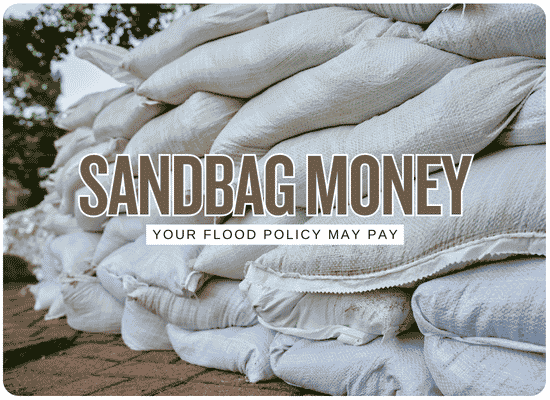
Buried inside National Flood Insurance Program coverage is a little-known benefit that can reimburse qualifying policyholders for sandbags, pumps, temporary barriers and even their own labor — before floodwater enters the building.
I’ve been around enough storm preparation to know how this normally goes. The river starts coming up, the weather service gets serious, and suddenly everybody is hunting for sandbags, plywood and a pump. Receipts get tossed on the truck seat because nobody is thinking about an insurance claim for something that hasn’t even happened yet.
That last part is the surprise. If you already carry an active National Flood Insurance Program policy, the policy may reimburse some of those costs. FEMA calls it Loss Avoidance Measures. The benefit is written into the Standard Flood Insurance Policy, but it receives a fraction of the attention given to ordinary flood-damage claims.
Potential reimbursement for qualifying sandbags, sand, temporary levee fill, pumps, plastic sheeting, lumber and eligible labor.
A separate allowance may cover reasonable expenses to remove insured property from the location when flood or imminent flood danger threatens it.
Yes, This Is Really in the Flood Policy
The National Flood Insurance Program is administered by FEMA and protects nearly five million policyholders. Its Standard Flood Insurance Policy contains a section called Coverage C — Other Coverages. Inside that section is the loss-avoidance provision.
For qualifying conditions, the policy provides up to $1,000 toward reasonable costs incurred to protect the insured building from flood or imminent danger of flood.
| Expense | Potentially Covered? | Important Detail |
|---|---|---|
| Sandbags | Yes | The policy specifically includes sandbags and the sand used to fill them. |
| Temporary levee fill | Yes | Fill used to construct a temporary protective barrier is specifically listed. |
| Water pumps | Yes | Pumps purchased as a qualifying loss-avoidance measure can fall within the $1,000 limit. |
| Plastic sheeting | Yes | Covered when used in connection with the qualifying protective measures. |
| Lumber | Yes | Covered when used in connection with the qualifying flood-protection measures. |
| Your own labor | Potentially | The policy assigns qualifying work by the policyholder or household member a value based on the federal minimum wage. |
| Permanent floodproofing | No, not under this benefit | FEMA’s claims guidance says this loss-avoidance provision does not pay for permanently installed protective measures. |
The normal NFIP deductible does not apply to Loss Avoidance Measures. That makes this very different from an ordinary building or contents claim where a deductible may absorb part of a smaller loss.
But There Is an Important Catch
This is not a standing $1,000 allowance that lets a policyholder buy flood equipment whenever a storm appears on television.
For the sandbags, supplies and labor provision, FEMA’s policy language sets a fairly specific test.
TEST
The threat has to be imminent.
Damage from flood must be imminent and the danger must be apparent enough that a reasonably prudent person would anticipate flood damage.
ONE
General flooding occurs nearby.
A general and temporary condition of flooding must occur in the area near the insured location. Importantly, the water does not have to actually reach the insured building.
TWO
An authorized official issues the qualifying order.
An evacuation order or another civil order can satisfy the policy condition when it calls for measures to preserve life and property from flood.
A severe forecast by itself is not necessarily enough for reimbursement of sandbags and supplies. The policy’s trigger language matters. Keep copies of flood warnings, evacuation orders and local emergency notices that help document what was happening when you purchased the supplies.
The Other $1,000 Is Different
The policy also provides up to $1,000 for reasonable expenses incurred to move insured property away from the described location to protect it from flood or imminent danger of flood.
Transportation
Reasonable costs associated with moving insured property away from the threatened location may qualify.
Temporary storage
FEMA claims guidance includes qualifying storage expenses associated with removing insured property to safety.
Labor
The policyholder’s and household members’ qualifying labor can be valued at the federal minimum wage.
It has to leave the location
Moving furniture from the first floor to the second floor is smart flood preparation, but it is not the same as the policy’s reimbursable “Property Removed to Safety” expense.
When insured property is properly moved to another location because of the flood threat, the SFIP can continue covering that property against flood at the temporary location for up to 45 consecutive days from the date the move begins, subject to the policy conditions.
A $2,000 Scenario
Consider a homeowner with an active NFIP policy facing an imminent river flood. Local officials issue an evacuation/civil order that calls for residents to protect life and property.
| Action | Example Cost | Potential Bucket |
|---|---|---|
| Sandbags and sand | $420 | Up to $1,000 Loss Avoidance Measures |
| Plastic sheeting and lumber | $190 | |
| Temporary pump | $310 | |
| Qualifying household labor | $80* | |
| Truck / moving expense | $420 | Separate $1,000 Property Removed to Safety limit |
| Temporary storage | $380 | |
| Qualifying moving labor | $200* |
*Example only. NFIP household labor is valued using the applicable federal minimum-wage provision rather than whatever hourly value a homeowner assigns to his or her own time. The federal minimum wage is currently $7.25 per hour.
In the right circumstances, those are two separate $1,000 limits. That is why describing this merely as “sandbag coverage” undersells it.
Five Things That Can Sink the Reimbursement
No active NFIP policy
This is an insurance benefit, not a general FEMA reimbursement program available to everyone.
The flood threat never meets the trigger
For sandbags, supplies and labor, the policy has the additional nearby-flooding or official-order requirement described above.
No receipts
FEMA claims guidance specifically tells policyholders to retain receipts for covered materials.
No labor log
If you want qualifying household labor considered, record who did the work, what they did and the time spent doing it.
Buying permanent improvements
This provision is focused on temporary loss-avoidance action. Permanently installed flood-mitigation projects have different rules and programs.
Assuming every flood policy is the same
This report concerns NFIP Standard Flood Insurance Policies. Private-market flood policies can contain different benefits and conditions.
What I Would Save Before the Water Comes
If you’re spending money because an insured property is facing an imminent flood, make a small claim file while you work. Five minutes of documentation can be worth more than an hour trying to reconstruct it afterward.
How to Make the Claim
Call the company that services your NFIP policy.
NFIP policies are administered by FEMA but are commonly sold and serviced by NFIP Direct or participating Write Your Own insurance companies.
Tell them you are claiming Loss Avoidance Measures.
Don’t assume the person handling the claim knows you purchased sandbags or paid moving expenses unless you specifically identify them.
Submit receipts and an itemized expense record.
List the materials, purchase amounts, moving or storage charges and qualifying household labor separately.
Include evidence of the qualifying flood threat.
Nearby flooding, emergency notices and evacuation or civil orders can become important when the insurer evaluates whether the policy requirements were satisfied.
Keep everything after payment.
Retain claim paperwork, receipts, photographs and correspondence with the insurer in case questions arise later.
One More Trap: You Can’t Buy the Policy at the Last Minute
Learning about this benefit while a hurricane is two days offshore does not mean someone without flood insurance can buy an NFIP policy that afternoon and immediately use the loss-avoidance benefit.
New NFIP policies ordinarily have a 30-day waiting period before coverage becomes effective. There are specific exceptions, including certain mortgage transactions, qualifying map changes and certain post-wildfire situations, but the general rule exists specifically to prevent people from waiting until a flood is already underway to purchase coverage.
This is flood-insurance coverage, not FEMA disaster assistance. The loss-avoidance benefit comes from an active NFIP Standard Flood Insurance Policy. You do not become eligible simply because a federal disaster declaration is issued.
Primary sources checked for this report
National Flood Insurance Program / FloodSmart — Flood Loss Avoidance guidance and flood-preparation checklist.
FEMA — National Flood Insurance Program Claims Manual, June 2025 edition.
FEMA — Standard Flood Insurance Policy and SFIP Commentary.
National Flood Insurance Program — Policy terms and waiting-period guidance.
U.S. Department of Labor — Current federal minimum wage information.
NFIP Loss-Avoidance Reimbursement Estimator
Enter what you spent or expect to spend. This tool illustrates the two NFIP loss-avoidance limits and checks several basic eligibility signals. It does not approve a claim.