
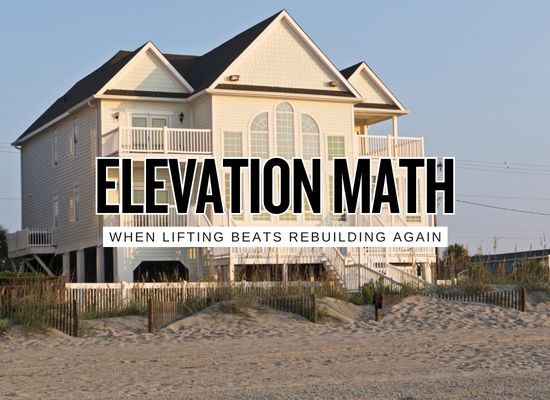
I would not wait for a third flood before doing the elevation math. After two rebuilds, the real question is not whether lifting a house feels expensive. It is whether staying at the same elevation has quietly become more expensive than the elevation project.
The second flood changes the decision
A first flood can feel like a rare event. A second flood changes the evidence. The owner now has a pattern: water reached the structure at least twice, repairs were expensive enough to matter, and the home’s elevation, drainage, floodplain setting, or nearby water source may be creating repeated exposure.
Elevating a house is disruptive and expensive. It can involve engineering, permits, utility disconnections, stairs, foundation work, temporary relocation, access changes, code requirements, floodplain review, and financing. But repeated rebuilding is also expensive. The owner pays deductibles, uninsured repair gaps, contents losses, temporary housing, contractor premiums, lost time, mold prevention, claim stress, and future resale pressure.
Elevation starts to become economically rational when expected future flood cost plus insurance and repair exposure is greater than the net cost of elevation after grants, premium savings, and resale benefit.
The calculation homeowners actually need
The elevation decision becomes clearer when each cost bucket is separated. A homeowner should not lump everything into “flood damage.” The economic trigger usually comes from several costs stacking together.
| Cost bucket | Staying low | Elevating | Decision clue |
|---|---|---|---|
| Expected future loss | Future building damage, contents damage, cleanup, mold prevention, and uncovered repairs | Reduced interior flood exposure if elevation is high enough and designed correctly | Repeated losses push the math toward elevation |
| Insurance premiums | Premium may remain high if First Floor Height and flood characteristics indicate risk | Potential premium reduction if elevation materially improves risk factors | Quote both scenarios before deciding |
| Deductibles | Deductible paid again after each covered loss | Less frequent claims if the home is elevated above likely flood levels | Deductibles matter over repeated events |
| Displacement | Hotel, rental, storage, meals, missed work, school disruption, and contractor waiting | Temporary relocation during the elevation project | One planned disruption may beat repeated emergency disruptions |
| Resale | Buyers may discount repeat-flood history, high insurance, and low elevation | Elevation records may make the property easier to explain | Resale benefit is not guaranteed but can be real in flood-aware markets |
| Grant funding | No reduction unless mitigation is funded and completed | FMA or other mitigation funding may reduce owner share if eligible | Grant eligibility can flip the decision quickly |
Home elevation break-even calculator
Use this planning tool to compare staying vulnerable against elevating the house. It is not an engineering estimate, appraisal, insurance quote, grant determination, or legal advice.
Calculator logic: expected future flood loss equals event loss multiplied by annual probability and decision years, plus insurance premiums over the same period. Net elevation cost equals project cost minus grants, premium savings, resale benefit, and expected loss reduction. Real projects require site-specific quotes, engineering review, insurance quotes, and local floodplain approval.
The five economic triggers
Elevation becomes easier to justify when several of these triggers appear together. One trigger may not be enough. Three or more should push the owner toward a serious elevation estimate.
01Repeated interior flooding
Two serious floods prove the home is not dealing with a one-time nuisance. If water reached finished living space twice, the homeowner should model future loss as a recurring exposure, not a surprise.
02Repair costs are rising faster than comfort
Drywall, cabinets, flooring, insulation, electrical work, HVAC equipment, appliances, mitigation contractors, and contents replacement can become more expensive after every major event. Contractor scarcity after disasters can add even more pressure.
03Insurance does not make the owner whole
Flood insurance can be essential, but deductibles, limits, depreciation, contents gaps, temporary housing, excluded items, and claim timing may still leave the owner with real out-of-pocket cost.
04Premiums and resale are becoming part of the problem
If buyers, lenders, and insurers all see the property as repeatedly exposed, the home may carry a discount even when freshly repaired. Elevation can make the property’s risk story easier to explain, especially when documented with permits and elevation records.
05Grant eligibility enters the picture
A project that does not make sense at full private cost may make sense if a mitigation grant covers a large share. Repetitive-loss and severe repetitive-loss status can matter, so homeowners should ask the local floodplain manager or emergency management office about available programs.
Elevation, relocation, repair, or sell
Elevation is not the only rational choice. The right answer depends on structure type, owner finances, local rules, flood depth, neighborhood trajectory, grant availability, and emotional tolerance for another rebuild.
| Path | Best fit | Financial strength | Hidden caution |
|---|---|---|---|
| Elevate | Structurally suitable home, repeated flooding, owner wants to stay, grant or premium savings possible | Can reduce future interior loss and improve long-term risk profile | High upfront cost, disruption, stairs or accessibility changes, site constraints |
| Mitigate without full elevation | Shallow nuisance flooding, garage or utility exposure, drainage-driven risk | Lower cost and faster than lifting the house | May not protect against deeper repeat floods |
| Repair again | Very low probability of repeat loss, short ownership horizon, no feasible elevation path | Lowest immediate cost | Can become the most expensive choice after repeated events |
| Relocate or buyout | Deep repetitive flooding, unsafe access, severe structural risk, community mitigation program | Can remove the household from the risk entirely | Availability, timing, valuation, emotional cost, and program eligibility vary |
| Sell as-is | Owner cannot tolerate another flood or fund mitigation | Ends future personal exposure | Repeated flood history, insurance cost, and mitigation needs may reduce price |
Data to collect before deciding
A homeowner should not hire a house-lifting contractor based on fear alone. The decision file should include flood, insurance, construction, and resale data.
- 01 Flood history for the house, yard, street, garage, crawlspace, and nearby access roads.
- 02 All flood repair invoices, contents replacement costs, mitigation bills, deductibles, and uncovered expenses.
- 03 Elevation Certificate if available, plus current First Floor Height and Base Flood Elevation comparison.
- 04 Current flood insurance premium and a post-elevation estimate from the insurance agent.
- 05 Local floodplain requirements for substantial damage, substantial improvement, freeboard, stairs, utilities, enclosures, and permits.
- 06 House-lifting quote, foundation quote, utility reconnection quote, engineering fee, permit cost, access changes, and temporary relocation budget.
- 07 Grant eligibility, local match, homeowner share, expected timeline, and reimbursement rules.
- 08 Resale comparison between elevated homes, repeatedly flooded homes, and repaired but unelevated homes in the same market.
The insurance math can surprise people
Flood insurance pricing is not only about being inside or outside a mapped zone. Current NFIP pricing uses property-specific risk variables, and elevation information can matter because First Floor Height affects risk assessment. Homeowners should ask for real quotes under both scenarios: current condition and elevated condition.
Insurance savings alone may not pay for the lift quickly. The bigger economic case often comes from combined savings: fewer future repairs, fewer deductibles, lower chance of contents loss, less displacement, lower claim stress, reduced future resale discount, and possible grant funding.
Grant funding can change the answer
Elevation at full private cost can be hard to justify for many households. Grant funding can change the decision because it reduces the owner’s net cost while targeting long-term risk reduction. Repetitive-loss and severe repetitive-loss properties are often the homes most likely to deserve attention.
| Grant factor | Reason it matters | Question to ask locally |
|---|---|---|
| NFIP-insured status | Some mitigation programs focus on NFIP-insured properties | Does my property qualify for Flood Mitigation Assistance or a local elevation program? |
| Repetitive-loss classification | Repeated claims may strengthen priority for mitigation funding | Is my home listed as repetitive loss or severe repetitive loss? |
| Benefit-cost review | Projects usually need to show that benefits justify cost | Will my past claims, flood depth, and expected future losses support the application? |
| Local sponsor | Homeowners often apply through a community or state process | Which parish, county, city, or state office handles applications? |
| Timeline | Grant projects can take longer than private repairs | Can I wait, or do I need temporary repairs before a decision? |
| Owner share | The remaining cost can still be substantial | What is my estimated out-of-pocket share after funding? |
Construction realities that affect the decision
The economics are not only spreadsheet numbers. Some houses are easier to elevate than others. The owner needs a realistic project file before assuming the lift is simple.
- 01 Foundation type matters. Pier-and-beam, crawlspace, slab, masonry, additions, and mixed foundations can create very different project complexity.
- 02 Utilities must be disconnected, extended, protected, or relocated. HVAC, electrical, plumbing, gas, sewer, water, and stairs all affect cost.
- 03 Accessibility may change. Higher stairs, ramps, lifts, parking, deliveries, pets, and aging-in-place needs should be included.
- 04 Local rules can affect enclosures below the elevated floor, flood vents, breakaway walls, parking, storage, and mechanical equipment.
- 05 Temporary relocation can be expensive. The owner may need storage, rental housing, pet arrangements, and a longer construction buffer than expected.
- 06 Elevation can expose other repair needs. Old framing, utilities, drainage, stairs, decks, porches, and additions may need upgrades during the project.
A practical decision rule
The homeowner does not need perfect certainty. The owner needs a rational threshold that prevents another emotional rebuild from becoming the default choice.
| Result from the math | Decision signal | Practical next move |
|---|---|---|
| Expected stay-low cost is far below net elevation cost | Elevation may not be financially justified yet | Focus on drainage, barriers, utility elevation, insurance, and claim documentation |
| Expected stay-low cost is close to net elevation cost | Decision depends on comfort, grant potential, resale, and ownership horizon | Get formal quotes and post-elevation insurance estimate |
| Expected stay-low cost is above net elevation cost | Elevation may be economically rational | Build grant file, contractor file, survey file, and financing plan |
| Future flood risk is deep, frequent, and dangerous | Elevation may not be enough | Ask about relocation, buyout, or broader mitigation options |
| Owner cannot fund elevation and cannot tolerate another loss | Financial stress may point toward selling or grant waiting | Get market advice, disclosure guidance, and mitigation-program information |
The practical homeowner takeaway
Elevating a repeatedly flooded house becomes economically rational when the long-term cost of staying low is higher than the net cost of lifting the structure. That long-term cost includes expected future repairs, contents losses, deductibles, insurance premiums, displacement, resale discount, and the likelihood of another damaging flood. The decision should be made with real numbers: elevation data, insurance quotes, contractor estimates, grant eligibility, repair history, and a realistic ownership horizon.