
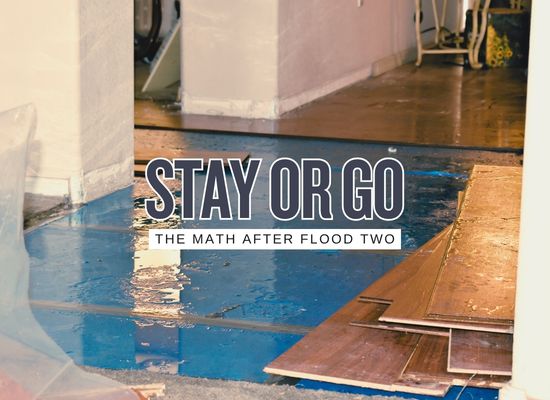
After a house floods twice, I would stop treating the next repair as an isolated event. The real decision is whether to put another dollar into the same elevation and the same flood path, spend serious money to change the building, or take the equity that is left and move the family somewhere the weather does not get another shot at the same rooms.
Start with five numbers
Emotionally, the choice can feel impossible. Financially, it gets much clearer once these numbers are on one sheet of paper.
The 50% number can change everything
| Example | Pre-damage building value | Cost to restore | Damage ratio | Signal |
|---|---|---|---|---|
| House A | $300,000 | $90,000 | 30% | Below federal 50% threshold |
| House B | $300,000 | $145,000 | 48.3% | Very close |
| House C | $300,000 | $165,000 | 55% | Potential substantial damage |
Option 1: Elevate the house
01Elevation makes the strongest case when the location is still worth keeping
The neighborhood, lot, schools, commute and resale market may still be excellent even though the floor elevation is wrong. In that situation, changing the house can make more sense than abandoning the property.
| Elevation signal | Favors elevation | Weakens elevation |
|---|---|---|
| Flood source | Predictable river, coastal or shallow flood elevation. | Deep fast water, erosion, scour, debris or access failure remains severe. |
| Required lift | Moderate elevation reaches required design level. | Very large lift creates major structural and access work. |
| Foundation | Engineer confirms structure is practical to elevate. | House geometry, slab, additions or condition make lifting difficult. |
| Future insurance | Elevation materially improves expected premium and future losses. | Residual risk and premium remain high. |
| Family plans | Owner expects to remain for many years. | Owner already expects to move soon. |
Option 2: Sell and leave the risk
02An ordinary sale can be rational even when repairing is technically possible
Selling deserves serious attention when the owner no longer wants the disruption, future insurance cost is uncomfortable, another flood would threaten finances, or elevation costs approach the equity in the property.
| Sale question | Number to obtain |
|---|---|
| Sell damaged | Actual investor or as-is market offers. |
| Repair then sell | Expected sale price minus repairs, carrying cost and transaction costs. |
| Buyer insurance burden | Current flood-insurance quote for the property. |
| Disclosure | State-specific seller disclosure requirements and known flood history obligations. |
| Replacement housing | Actual cost of buying or renting somewhere safer. |
Option 3: Ask about a voluntary buyout
03A buyout permanently removes the structure from the flood cycle
For repeatedly flooded properties where elevation is too expensive or the entire site remains dangerous, acquisition can be the cleanest mitigation. The home is purchased, the structure is removed and the land generally remains permanent open space.
| Buyout reality | Meaning |
|---|---|
| Voluntary | The homeowner chooses whether to participate. |
| Local first | Contact the local emergency manager or floodplain administrator. Individual homeowners generally do not submit a FEMA acquisition application directly. |
| Valuation | Eligible programs may use pre-disaster fair market value established through appraisal rules. |
| Not immediate | Local, state and federal review can make acquisition much slower than a normal real-estate sale. |
| Permanent | FEMA-funded acquired parcels generally receive open-space deed restrictions. |
Option 4: Rebuild it again
04Rebuilding is cheapest only when the next flood is unlikely to repeat the same loss
Rebuilding can still be reasonable when damage is below the substantial-damage threshold, the flood source can be materially mitigated, repair costs are manageable and the house retains enough elevation or drainage margin to avoid repeating the same claim.
| Rebuild test | Good answer | Bad answer |
|---|---|---|
| Same flood depth next time? | Mitigation meaningfully reduces entry. | The repaired floor will sit exactly where it flooded twice. |
| Mechanical systems? | HVAC, electrical and water heater move higher. | Expensive equipment returns to the same elevation. |
| Materials? | Lower areas use flood-resistant construction where appropriate. | Drywall, cabinets and vulnerable finishes simply go back. |
| Insurance? | Future premium and deductible remain affordable. | Coverage becomes a major annual carrying cost. |
| Third-loss capacity? | Household could financially survive another event. | Another deductible, hotel stay and repair would be financially destabilizing. |
The fastest decision board
| Situation | Option worth investigating first |
|---|---|
| Great location, long-term owner, elevation technically feasible, repeat shallow flooding | Elevate |
| Owner wants out, good remaining equity, normal market still functions | Sell |
| Repeated severe loss, site itself remains hazardous, community acquisition program exists | Buyout |
| Repair cost modest, flood source corrected, future exposure low | Rebuild + mitigate |
| Repair cost near 50% of structure value in regulated floodplain | Stop and get local determination first |
| Elevation cost approaches home equity and flood risk remains after elevation | Exit deserves serious review |
Money homeowners often miss
| Funding or value | Use | Catch |
|---|---|---|
| Flood insurance claim | Covered building and contents loss. | Coverage limits, deductibles and exclusions still apply. |
| ICC coverage | Up to $30,000 for qualifying compliance work. | Eligibility and local substantial/repetitive damage determination matter. |
| FEMA mitigation grant | Potential elevation, acquisition, relocation or mitigation reconstruction. | Usually requires state/local sponsorship, funding availability and project approval. |
| Local/state mitigation funds | Can supplement federal or owner funding. | Availability varies dramatically. |
| Future premium savings | Elevation and mitigation may reduce long-term insurance cost. | Get an actual post-mitigation insurance estimate before counting savings. |
The first seven calls after flood number two
| # | Call | Question |
|---|---|---|
| 1 | Flood insurer / adjuster | What is covered and could ICC apply? |
| 2 | Local floodplain administrator | Has a substantial-damage determination been made? |
| 3 | Licensed contractor | What is the complete restore-to-pre-damage cost? |
| 4 | Elevation contractor / engineer | How high must the house go and what is the full project cost? |
| 5 | Flood insurance agent | What would insurance cost rebuilt versus elevated? |
| 6 | Local mitigation office | Are elevation grants or acquisition programs open or planned? |
| 7 | Real-estate agent / appraiser | What is the realistic as-is, repaired and mitigated market value? |
Flooded Twice Decision Tool
Compare rebuilding, elevation and selling using your own numbers. The model uses expected future losses as a planning estimate, not a prediction.
Expected-loss math assumes the selected flood interval repeats evenly across the planning horizon. Real floods do not behave that neatly. The model also assumes the elevation cost entered is additional to ordinary flood repairs. Confirm actual code requirements, grant eligibility, insurance pricing and engineering feasibility before making a property decision.
The tighter takeaway
After flood number two, rebuilding should no longer be the default. First determine whether local substantial-damage rules change what is legally possible. Then price the complete elevation, calculate the likely cost of another flood, get an actual sale number and ask whether a voluntary acquisition program exists. Elevation makes sense when the location remains valuable and changing the floor height removes most of the future loss. Selling or a buyout gets stronger when the site itself remains the problem. Rebuilding makes sense only when the next repair is not simply recreating the conditions that produced the first two losses.