
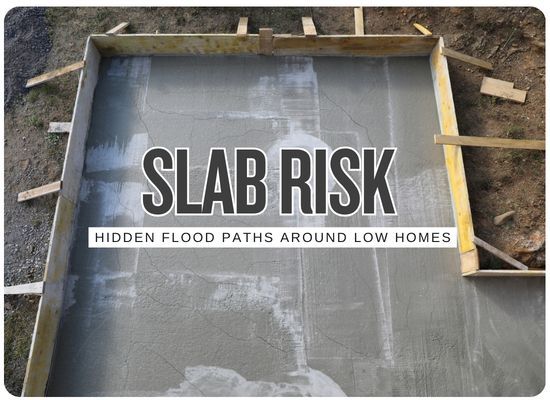
Slab homes can flood quietly before the water looks dramatic. The weak points are usually ordinary features: a garage apron, a patio slider, a shallow front stoop, a side-yard swale, a flower bed, a short downspout, a clogged drain, or a low HVAC pad. The danger is that the finished floor is close to the ground, so small grading mistakes leave very little margin.
The slab home flood trap
Raised homes often give water a visible buffer. Basements show trouble as water collects below living space. Slab homes are different. The finished floor may sit only inches above patios, driveways, sidewalks, flower beds, and surrounding grade. That makes water management outside the walls the main defense.
The practical goal is not to panic about every slab foundation. Many slab homes perform well. The goal is to identify whether the house has enough separation between outside water and inside flooring, and whether the drainage system moves water away before it touches low doors, walls, utility equipment, or the garage.
During a heavy rain, water should move away from the house faster than it collects near doors, walls, patios, and the garage.
Sharp risk points to inspect around a slab home
The strongest slab-home check is a slow walk around the house after rain. These are the hidden risk points that deserve the closest look.
01Negative grade against the slab
Soil, sod, and hard surfaces should not push water toward the house. Even a gentle inward slope can send sheet flow to a door threshold or exterior wall. Look for low strips along the foundation, soggy side yards, or places where water stains show repeated ponding.
02Short downspouts near doors and walls
Roof water is concentrated water. A short downspout can dump hundreds of gallons near the slab during a storm. Extensions, splash blocks, buried discharge lines, or safe surface flow paths can move that water away before it becomes a door or wall problem.
03Mulch stacked too high
Landscape beds often rise over time as new mulch is added. High beds can hold moisture against siding, cover weep holes, hide the slab edge, and reduce the clearance between outside grade and inside floor.
04Patios that drain toward sliders
A patio can look harmless until rainwater starts moving across it toward a sliding door. Slab homes with patio sliders need enough threshold height, working drainage, and a surface that does not tilt inward.
05Garage aprons that collect driveway flow
The garage is often the first flood room because the opening is wide and low. If the driveway slopes toward the garage, even shallow water can enter before the living space is touched.
06Side-yard squeeze points
Narrow spaces between houses can become water corridors. Fences, sheds, AC pads, raised beds, and poor grading can block flow and send water against the slab, especially in dense subdivisions.
07Low utility equipment
HVAC condensers, generators, pool equipment, irrigation controls, exterior outlets, water heaters, and electrical components can sit in the first flood path. A home may avoid interior water while still losing expensive equipment.
08Interior finishes too close to the first waterline
Carpet, wood trim, low cabinets, pressed-wood furniture, cardboard storage, and floor-level electronics can turn a small water event into a costly cleanup. The lowest 12 inches of a slab home deserve special attention.
Drainage and landscaping red flag table
This table turns common yard details into a practical risk readout for slab homes.
| Visible clue | Slab-home concern | Better direction | Buyer or owner note |
|---|---|---|---|
| Soil slopes inward | Water flows toward walls and thresholds | Regrade, add swales, or install drains with a safe outlet | Do not redirect water onto neighbors |
| Mulch touches siding | Moisture is held against the wall and weep holes may be covered | Lower beds and restore clearance along the wall | Check for rot, pests, and hidden prior water marks |
| Short downspout | Roof water is dumped near the slab | Extend discharge away from the home | Watch the discharge point during heavy rain |
| Flat patio | Water may sit near slider or back door | Improve surface drainage or add a channel drain where appropriate | Look for swollen trim or stains inside |
| Driveway slopes to garage | Garage becomes the first flood entry | Review trench drain, regrading, or garage threshold protection | Raise storage and document contents |
| Side-yard ponding | Water pressure builds beside the slab | Clear flow path, lower obstructions, add drain or swale | Check neighbor runoff and fence-line barriers |
| Low AC pad | Mechanical equipment may flood before living space | Raise pad or improve drainage around equipment | Use licensed trades for utility work |
Slab home hidden flood risk score
Use this planning tool to identify whether a slab home has small exterior problems that could become an interior water event. It is not an engineering report, insurance decision, or guarantee of flood protection.
Score logic: grade, low openings, garage flow, landscaping clearance, drainage condition, and low equipment exposure are combined into a 100-point planning score. The exposure signal compares estimated shallow-water damage with a first-fix budget.
Doors and garages need their own inspection
Doors and garages are often treated as simple maintenance items, but they can be the first place a slab home fails during heavy rain.
| Opening | Risk pattern | Practical upgrade | Careful detail |
|---|---|---|---|
| Front door | Walkway, stoop, or yard sends water toward threshold | Improve approach drainage, replace worn sweep, stage temporary barrier | Keep entry safe and accessible |
| Patio slider | Patio surface sits nearly level with interior floor | Clear patio drain, add channel drainage, review surface slope | Watch for swollen base trim inside |
| Garage door | Driveway flow reaches the wide opening first | Replace bottom seal, add threshold strip if suitable, consider trench drain or barrier | Threshold strips can trap water inside if misused |
| Garage service door | Side-yard water enters through low side door | Improve side-yard flow and use door protection | Side gaps often matter more than the center of the door |
| Utility penetration | Water follows lines, pipes, vents, or cracks | Seal appropriate gaps and correct exterior water source | Use proper materials and avoid trapping water inside wall systems |
Landscaping can quietly erase slab clearance
Landscaping is one of the most overlooked slab-home risks because it changes slowly. Every new layer of mulch, every raised bed, every border stone, and every settled low spot can change how water behaves near the wall.
- 01 Keep mulch, soil, and decorative rock below weep holes, siding edges, and low wall transitions.
- 02 Avoid raised beds that trap water against the house or block side-yard flow.
- 03 Use plantings to slow runoff, but do not create a bowl against the slab.
- 04 Keep irrigation heads from spraying walls, doors, and garage seals.
- 05 Check that edging, stones, and landscape timbers do not act like small dams.
- 06 Refresh grading after soil settles around walkways, patios, and utility trenches.
- 07 Use rain gardens or planted drainage areas only where overflow can move safely away from the structure.
Owner fixes ranked by impact
Slab-home flood reduction should start with the fixes that change the most water behavior for the least complexity.
| Priority | Fix | Impact | Best fit |
|---|---|---|---|
| High | Extend downspouts away from the slab | Moves concentrated roof water away from walls and doors | Short discharge points and wet foundation edges |
| High | Correct obvious negative grade | Stops sheet flow from running toward the home | Side yards, low corners, patios, front walks |
| High | Clear drains, ditches, and culvert openings | Restores flow before water reaches openings | Slow street drainage, yard ponding, driveway flow |
| Medium | Refresh garage and door seals | Reduces nuisance seepage and wind-driven rain | Minor water under doors, leaf gaps, worn rubber seals |
| Medium | Stage temporary door or garage barriers | Can slow shallow water at known first-fail openings | Predictable driveway or street ponding |
| Targeted | Raise HVAC, generator, and pool equipment | Reduces expensive equipment loss | Low pads in ponding areas |
| Targeted | Use flood-tolerant lower finishes | Reduces tear-out after shallow water | Repeated nuisance flooding or low rooms |
Buyer checks before closing on a slab home
A slab home that looks clean during a showing can still have drainage risk. Buyers should treat the exterior ground plane as part of the inspection.
- 01 Ask whether the structure, garage, yard, driveway, patio, or street has ever flooded.
- 02 Visit after rain if possible, or ask for photos from recent heavy rain events.
- 03 Check whether new flooring, baseboards, cabinets, drywall, or paint could be hiding prior water repairs.
- 04 Look for water stains, swollen trim, musty smells, lifted flooring, or fresh caulk near low doors.
- 05 Ask the inspector to pay special attention to grading, weep holes, patios, garage thresholds, and drainage.
- 06 Get flood insurance pricing early, even if the lender does not require it.
- 07 Price near-term fixes before making the final offer, especially drainage, garage protection, and utility elevation.
Insurance and documentation still matter
Slab-home prevention lowers the chance and severity of loss, but it does not remove flood risk. Owners should keep a current home documentation file and understand the difference between flood coverage, homeowners coverage, water backup endorsements, and contents coverage.
| Record to keep | Reason it helps | Slab-home detail to include |
|---|---|---|
| Room videos | Shows pre-loss condition and contents | Film low doors, baseboards, flooring, cabinets, and garage storage |
| Exterior drainage photos | Shows maintenance and water-management efforts | Include downspouts, drains, ditches, patios, driveway, and wall clearance |
| Utility serial numbers | Supports claims for damaged equipment | Photograph HVAC, generator, pool equipment, water heater, and electrical components |
| Repair invoices | Proves upgrades and recent condition | Keep drainage, grading, door, garage, HVAC, and plumbing receipts |
| Insurance file | Reduces confusion after a storm | Save policy pages, limits, deductible, claim contacts, and mortgage information |
The practical slab-home takeaway
Slab homes do not usually fail because of one dramatic flaw. They fail when small exterior details allow water to reach the living floor: poor slope, short downspouts, high mulch, low thresholds, patio ponding, garage driveway flow, blocked side yards, and low equipment. The best plan starts outside, follows the water path, fixes the easiest drainage problems first, protects low openings, raises vulnerable items, and keeps flood insurance plus documentation ready.