
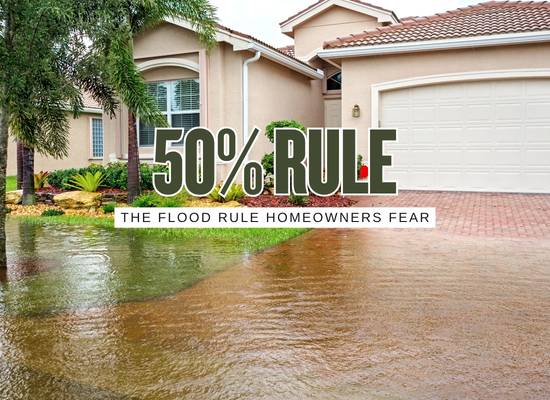
The 50% rule is not just an insurance term. It is a permitting and floodplain compliance trigger that can change the rebuild path after a flood.
The rule in plain homeowner language
The basic idea is simple: if the cost to restore the damaged structure equals or exceeds 50% of the structure’s pre-damage market value, the building may be classified as substantially damaged. Once that happens, repairs are usually treated as a substantial improvement, and the building may have to comply with current floodplain rules before permits move forward.
The hard part is that the calculation is not based on the homeowner’s emotions, the mortgage balance, the purchase price, the insurance payout, or the value of the land. It is a comparison between repair cost and the pre-damage value of the structure itself. Local officials administer the determination through the community’s floodplain management ordinance and building permit process.
Two numbers drive the decision
Almost every substantial-damage dispute comes down to two numbers. One is the structure value before the flood. The other is the cost to restore the structure to its before-damaged condition.
This is the value of the building before the flood damage occurred. Land value is not the target number. A coastal lot may be worth a fortune, but the 50% test usually focuses on the structure.
This is the estimated cost to bring the building back to its before-damaged condition. It can include materials, labor, demolition related to repair, contractor overhead, and other repair-related costs considered by the local official.
If the ratio reaches the community’s threshold, the substantial-damage rule can be triggered. The federal minimum standard is commonly 50%, but some communities may apply stricter or cumulative local rules.
Substantial damage is not the same as a total loss
This is the mistake that causes the most confusion after a flood. Substantial damage does not necessarily mean the home is physically destroyed. It also does not automatically mean the insurance company owes the full policy limit. It means the repair-cost percentage has crossed the compliance threshold used by the local floodplain rules.
| Term | Main decision | Handled by | Homeowner impact |
|---|---|---|---|
| Substantial damage | Repair cost reaches the threshold compared with pre-damage structure value | Local building or floodplain official | May trigger current floodplain compliance before permits are approved |
| Insurance claim payment | Covered flood damage under the policy terms | Flood insurer or claim adjuster | May pay less than the cost to fully comply with new rules |
| Total loss language | Insurance or practical rebuild economics | Insurer, owner, lender, contractor, local officials | Not the same as the floodplain substantial-damage determination |
| Permit approval | Whether proposed work satisfies local code and floodplain ordinance | Local permitting office | Repairs may be delayed until value, cost, and compliance are resolved |
| ICC eligibility | Potential extra NFIP help for compliance work after qualifying damage | NFIP claim process and local determination | May provide up to $30,000, but it may not cover the full mitigation cost |
Eight decisions that can change the rebuild
After a flood, the 50% rule can become the pivot point between a basic repair project and a full compliance project. These are the decision areas owners should understand early.
-
01
Local authority
The city or county usually makes the call
FEMA sets NFIP minimum standards and provides guidance, but local governments administer floodplain ordinances, issue permits, and make substantial-damage determinations. After a disaster, local officials may inspect properties, use FEMA-supported tools, request contractor estimates, or require owner-submitted documentation.
Owner move: Ask the building department or floodplain administrator for the exact local process, appeal path, forms, structure value method, and repair-cost documentation rules. -
02
Value dispute
The structure value can be lower than expected
Many owners think the threshold should be based on the full property value. That can be a painful surprise in high-land-value markets. The 50% test generally focuses on the building value, not the land, landscaping, pool, dock, driveway, or neighborhood premium.
Owner move: If the local value seems too low, ask whether an independent appraisal of the pre-damage structure value is allowed and which appraisal standards the community accepts. -
03
Repair cost
The cost side may include more than visible repairs
The repair-cost estimate may include labor and materials needed to restore the structure to before-damaged condition, even if the owner plans to do some work personally or receives discounted help. This can push the calculation higher than a homeowner’s out-of-pocket plan.
Owner move: Request a written list of included and excluded repair-cost items before assuming the estimate is wrong. -
04
Permit timing
Fast cleanup is not the same as permitted repair
Emergency actions such as drying, debris removal, safety work, and mold prevention may happen quickly. But structural repair, electrical replacement, drywall restoration, HVAC replacement, or rebuilding may still require permits and floodplain review.
Owner move: Separate emergency stabilization from permanent repair. Keep photos, receipts, and contractor notes for both. -
05
Compliance path
Elevation may become the central rebuild issue
If a substantially damaged home is in a regulated flood hazard area, compliance may require the lowest floor to meet current elevation rules. In many cases, that can mean elevating the structure, rebuilding higher, relocating, or demolishing and rebuilding to current standards.
Owner move: Ask for the required flood elevation, freeboard rule if any, foundation options, utility-elevation requirements, and whether flood vents or enclosure rules apply. -
06
Insurance gap
The claim may not cover the compliance jump
Flood insurance may pay for covered damage, but the added cost to comply with current floodplain rules can be much larger than the damage payment. Increased Cost of Compliance coverage can help eligible NFIP policyholders, but the maximum benefit may be far below the cost of elevation or major reconstruction.
Owner move: Ask the adjuster and local official whether ICC may apply, then compare that number with real elevation, demolition, utility, stairs, engineering, and temporary-housing costs. -
07
Local variations
Some communities are stricter than the federal floor
The 50% rule is the familiar benchmark, but communities may adopt higher standards, lower thresholds, cumulative tracking, freeboard requirements, or local permit rules. A homeowner should never rely only on a generic national explanation after a flood.
Owner move: Ask whether your community uses a single-event threshold, a cumulative period, a lower percentage, or local freeboard above the mapped flood elevation. -
08
Appeal file
The first letter may not be the final word
Some homeowners receive a preliminary substantial-damage letter based on field inspections, estimated damage, or available structure value data. If the owner disagrees, the strongest response is usually a clean file with appraisals, contractor scopes, damage photos, repair estimates, and written questions.
Owner move: Do not argue only verbally. Build a document packet and ask for the formal reconsideration or appeal process in writing.
Repair cost items that can surprise owners
The repair estimate used for substantial damage is not always the same as the homeowner’s cheapest path back into the house. It may represent the cost to restore the structure to its pre-damage condition under accepted estimating rules.
| Cost category | Usually part of the discussion | Owner misconception | Document to gather |
|---|---|---|---|
| Labor | Skilled trade labor, contractor labor, repair labor value | Owner plans to do it personally, so it should count as zero | Local guidance on labor valuation and contractor estimates |
| Materials | Drywall, framing, flooring, cabinets, insulation, doors, trim, mechanical items | Donated or discounted materials should remove the cost from the calculation | Itemized scope and material list |
| Demolition tied to repair | Removing damaged materials so restoration can happen | Gut-out work is separate and should not matter | Demolition invoice and repair scope |
| Mechanical electrical plumbing | HVAC, water heater, electrical panel, wiring, plumbing fixtures, service equipment | Only visible living-space finishes count | Trade estimates and permit notes |
| Structural repair | Foundation, framing, load-bearing walls, subfloor, stairs, supports | Structure sounds like only the foundation | Engineer or contractor report |
| Excluded or separate items | Items vary by local rules and project facts | Every dollar after a flood counts the same way everywhere | Written local inclusion and exclusion list |
Compliance paths after the threshold is crossed
If the structure is found substantially damaged, the owner may need to bring the building into compliance with current floodplain standards. The exact path depends on flood zone, building type, local ordinance, elevation data, construction method, and whether the building is residential or nonresidential.
| Path | Typical use | Cost pressure | Owner question |
|---|---|---|---|
| Elevate the existing structure | Older homes below required flood elevation | High | Can the existing structure be lifted safely, and what happens to utilities, stairs, decks, and access? |
| Demolish and rebuild higher | Severely damaged homes, poor foundations, major redesigns | Very high | Will rebuilding trigger zoning, setback, elevation, parking, access, or design restrictions? |
| Relocate the structure | Lots with safer buildable area or relocation opportunity | High | Is there a legal and practical place to move the building? |
| Floodproof certain nonresidential buildings | Commercial or nonresidential structures where allowed | Variable | Is dry floodproofing allowed for this building type and flood zone? |
| Abandon, demolish, or pursue buyout options | Repeated flood loss or unaffordable compliance | Case specific | Are acquisition, mitigation grants, or local recovery programs available? |
FEMA 50 Percent Rule Snapshot Tool
This calculator gives a rough look at the substantial-damage percentage. It is not a local determination, legal opinion, insurance decision, or permit approval.
Enter the structure value and repair estimate to see the rough percentage.
Use this only as a planning tool. Local officials decide the actual method, accepted values, included repair costs, appeal rules, and compliance path.
Document packet after a flood
A homeowner facing a 50% rule review should build a serious file quickly. The goal is not to overwhelm the local office. The goal is to make the value, damage, repair scope, and compliance questions clear.
- ① Local substantial-damage letter. Keep the notice, inspection notes, deadlines, contact name, parcel number, and appeal instructions.
- ② Pre-damage structure appraisal. Ask whether the community accepts an independent appraisal and which valuation date matters.
- ③ Property appraiser record. Separate building value from land value and ask whether local adjustment factors apply.
- ④ Insurance estimate. Keep the flood adjuster estimate, proof of loss materials, and claim payment details.
- ⑤ Contractor line-item scope. Use detailed repair categories instead of a single lump-sum rebuild number.
- ⑥ Damage photos and video. Show water line, damaged rooms, exterior conditions, utilities, crawlspace, garage, foundation, and mechanical systems.
- ⑦ Permit history. Include prior renovations, elevation certificates, flood vents, substantial improvement records, and previous repair permits.
- ⑧ Compliance estimates. Price elevation, demolition, utility relocation, stairs, engineering, foundation, temporary housing, and design work if the threshold is crossed.
- ⑨ ICC and grant questions. Ask about Increased Cost of Compliance, mitigation grants, local recovery programs, and buyout eligibility if rebuilding becomes unaffordable.
- ⑩ Written timeline. Track every call, email, inspection, permit submission, estimate, and document request.
Owner mistakes that create bigger problems
The period right after a flood is stressful, but early decisions can affect permits, insurance, financing, and resale. These are the mistakes that can make the 50% rule harder to navigate.
| Mistake | Potential result | Better move |
|---|---|---|
| Starting permanent repairs without permits | Stop-work orders, compliance issues, insurance problems, resale trouble | Confirm emergency work versus permitted reconstruction before rebuilding |
| Using purchase price as the threshold | Owner overestimates the repair budget allowed under the rule | Separate structure value from land and other property value |
| Submitting a vague contractor bid | Local official cannot separate included and excluded costs | Get itemized repair scopes with labor and materials broken out |
| Assuming insurance payment equals repair cost | Owner misses the difference between claim settlement and compliance estimate | Compare insurance estimate, contractor estimate, and local substantial-damage estimate |
| Ignoring local stricter rules | Owner relies on the generic 50% number when local rules are tighter | Ask about cumulative tracking, freeboard, and local threshold before planning |
| Waiting too long to challenge a value | Appeal deadlines, permit deadlines, or rebuilding decisions become harder | Ask for the reconsideration process immediately after receiving a notice |
Buyer and seller impact
The 50% rule also matters in real estate transactions. A buyer looking at a flood-damaged home, storm-repaired home, or older home in a mapped flood area should ask whether substantial damage or substantial improvement issues are already in the file.
- ① Ask for floodplain permits. A repaired home should have a permit trail, not just new drywall and flooring.
- ② Request prior substantial-damage letters. If the property received a notice, buyers need to see the resolution.
- ③ Review elevation certificates. The lowest floor, enclosure, garage, utilities, and flood vents may affect compliance and insurance.
- ④ Check cumulative improvement rules. Some local systems track improvements over time, not only one project.
- ⑤ Price future renovations carefully. A buyer planning a large remodel may trigger substantial improvement even without a new flood.
- ⑥ Confirm insurance cost. A home repaired under older standards may carry a different flood premium and future compliance risk.
Bottom line for flooded homeowners
The FEMA 50% rule can change a flood recovery from a repair job into a compliance project. The key comparison is the cost to restore the structure versus the pre-damage market value of the structure. If the repair cost reaches the threshold used by the local community, the owner may have to bring the building into current floodplain compliance before permits are approved.
The best response is fast documentation. Get the local rule in writing, separate land value from structure value, request the accepted valuation method, gather line-item repair estimates, ask about ICC, and price the real compliance path before making rebuild promises to a lender, buyer, contractor, or family member.