
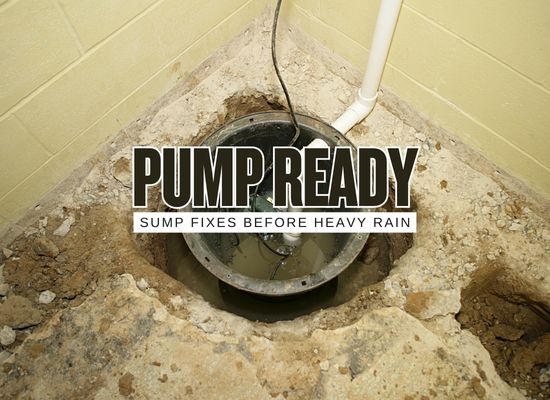
A sump pump can save a basement, but only if the whole system is ready before the storm arrives. The pump, pit, power, discharge line, check valve, alarm, and backup plan all matter.
The sump pump is only one piece
Most homeowners talk about the pump, but the real flood-prevention system is bigger than that. Water must reach the sump pit, the float must trigger correctly, the pump must have enough capacity, the discharge line must move water away from the house, and backup power must be ready if the storm knocks electricity out.
A sump system can fail even when the pump motor is fine. The float switch can stick. The check valve can fail. The outlet can trip. The discharge pipe can freeze, clog, or send water right back to the foundation. The pump can be undersized for a heavy rain event. The pit can fill with debris. That is why a sump pump should be treated as a small mechanical system, not a forgotten appliance in a corner.
Simple sump system flow
This is the cleanest way to think about basement water protection. If any step breaks, the basement can still flood.
Foundation drains, interior drain tile, or ground water must move toward the sump pit instead of spreading across the basement.
The basin needs enough space, a secure lid when appropriate, and protection from debris that can jam the pump or switch.
The float switch or sensor must rise freely, start the pump, and stop the pump without short-cycling.
Water should move to a safe discharge point, not back to the wall, into a clogged line, or toward a neighbor.
Battery backup, water-powered backup, alarms, and generator planning protect against outage, pump failure, and rising water while nobody is watching.
12 sump pump moves that can prevent a basement flood
-
①
Storm readiness
Test the pump before the rain season starts
The easiest sump pump test is also the one many homeowners skip. Pour water into the pit until the float rises. The pump should turn on, remove the water quickly, and shut off without grinding, rattling, or cycling repeatedly.
Basement saver: Test it during dry weather, not when the floor is already wet. If the pump hesitates, hums, or fails to start, call a plumber before the next heavy rain. -
②
Hidden failure point
Check the float switch for free movement
The float switch is often the smallest part that creates the biggest mess. If it catches on the pit wall, pump cord, lid, debris, or discharge pipe, the pump may never turn on. A working motor does not matter if the switch cannot trigger it.
Fast check: Lift the float gently and confirm the pump starts. Then make sure the float drops cleanly when the water level falls. -
③
Power outage protection
Add battery backup before the power fails
Heavy rain and power outages often happen together. A battery backup pump gives the system a second line of defense when the main pump loses power or fails during the storm. This is especially valuable for finished basements, crawlspaces with mechanical equipment, and homes with frequent outages.
Typical budget: Many battery backup installations land around the hundreds to low thousands, depending on the pump, battery, controls, and labor. -
④
Water exit strategy
Extend the discharge line far enough from the house
A sump pump can run perfectly and still fail the home if the discharge line dumps water beside the foundation. That water may seep back down and re-enter the sump pit, causing endless cycling and higher flood risk.
Good target: Direct discharged water well away from the foundation, with enough slope and a clear outlet. Avoid sending it into a place that freezes, clogs, or violates local rules. -
⑤
Backflow control
Make sure the check valve works
The check valve keeps pumped water from flowing back into the pit after the pump shuts off. Without it, the pump may move the same water over and over, wearing itself down and reducing capacity during a storm.
Failure clue: If water rushes back into the pit after each pump cycle, the valve may be missing, stuck, installed wrong, or worn out. -
⑥
Crawlspace and basement fit
Choose the right pump style for the space
Submersible pumps sit inside the pit and are common for basements. Pedestal pumps keep the motor above the pit and can be easier to service in some setups. Crawlspace and exterior systems may require more site work, drainage planning, and protective installation.
Cost clue: A simple replacement is much cheaper than cutting a new pit, building drainage, adding a discharge route, or installing in a difficult crawlspace. -
⑦
Capacity check
Do not undersize the pump for real storm water
A pump that handles normal seepage may not keep up during a major storm, rapid snowmelt, or repeated thunderstorm rounds. Capacity should match the water load, vertical lift, discharge distance, pipe size, and how often the system runs during heavy rain.
Good contractor question: “Is this pump sized for the gallons entering the pit during a heavy rain, or just for normal basement seepage?” -
⑧
Smart alert
Install a high water alarm
A sump alarm can warn the homeowner before water spreads across the floor. Smart alarms can send phone alerts, which matters for travelers, landlords, second homes, and families away during storms.
Best placement: Put one alarm near the sump pit and consider extras near floor drains, water heaters, laundry rooms, and low basement corners. -
⑨
Debris defense
Keep the pit clean and covered
Dirt, gravel, toys, insulation, rust flakes, and construction debris can jam the float or clog the pump intake. A lid can reduce debris, odor, humidity, and safety issues, especially in finished basements.
Simple routine: Look inside the pit with a flashlight, remove debris, confirm the pump sits level, and make sure the lid does not interfere with the float. -
⑩
Insurance gap
Review water backup coverage
Homeowners often assume a sump pump overflow is automatically covered by a standard home policy. That assumption can be expensive. Water backup coverage is commonly handled as a separate endorsement or add-on, and flood insurance is a different coverage category.
Agent question: “Do I have coverage for sewer backup, drain backup, or sump pump overflow, and what is the limit?” -
⑪
Backup route
Consider a water-powered backup in the right house
Water-powered backup pumps can work without electricity by using municipal water pressure. They are not right for every property, and they are not usually used with well water systems, but they can be useful in certain homes where battery runtime is a concern.
Check first: Ask about local plumbing rules, water pressure, backflow protection, utility cost, and whether the system is allowed in your area. -
⑫
System thinking
Pair the sump pump with exterior water control
A sump pump is the last stop for water that already reached the basement drainage system. The best plan also reduces how much water gets there in the first place. Gutters, downspouts, grading, swales, window wells, and yard drains can lower the load on the pump.
Best result: Less water entering the pit means fewer pump cycles, lower failure risk, and a better chance the system keeps up during the storm.
Sump pump cost and fit table
Prices vary by region, access, pump type, pit condition, discharge route, and whether the home already has a working sump basin. Use this table as a practical planning guide before calling contractors.
| System choice | Typical installed range | Best fit | Watch item |
|---|---|---|---|
| Pedestal sump pump | $800 to $1,500 | Simple pits, easier service access, lower upfront cost | Motor sits above pit and may be louder or less protected |
| Submersible sump pump | $1,200 to $3,000 | Basements needing stronger, quieter, in-pit pumping | Needs a proper pit, reliable switch, and clean intake |
| Battery backup add-on | $1,000 to $2,000 | Finished basements, outage-prone areas, frequent storms | Battery testing and replacement schedule matter |
| Water-powered backup | $1,200 to $2,500 | Homes with municipal water and suitable plumbing | Not ideal for well systems and may need local approval |
| Crawlspace or exterior system | $1,500 to $4,000 plus | Crawlspaces, low areas, difficult water collection points | Access, drainage design, and discharge location can raise cost |
| Dual pump system | Often $2,000 to $4,000 plus | Higher-risk homes needing redundancy | Confirm both pumps can discharge safely during peak water flow |
Failure signs homeowners should not ignore
A sump pump usually gives warning signs before it fails completely. Catching those signs early can prevent a wet basement during the next storm.
| Warning sign | Possible problem | Homeowner move |
|---|---|---|
| Pump runs constantly | Stuck switch, undersized pump, bad discharge route, high water load | Check the float, discharge point, and whether water is cycling back to the pit |
| Pump turns on and off rapidly | Short cycling, pit too small, switch issue, failed check valve | Have the switch, basin, and check valve inspected |
| Water returns after shutdown | Bad or missing check valve | Replace or reinstall the check valve correctly |
| Loud grinding or rattling | Debris, worn motor, loose parts, pump not level | Stop relying on it until it is cleaned or serviced |
| Pump hums but does not move water | Jammed impeller, failed motor, clogged line, frozen discharge | Call for service and use emergency water control if needed |
| Bad smell from pit | Stagnant water, debris, missing lid, possible drainage issue | Clean the pit and check whether water is sitting too long |
| Backup battery alarm sounds | Weak battery, charger issue, backup pump trouble | Test the battery system before the next storm |
Sump Pump Flood Risk Checker
Use this quick tool to estimate whether your sump setup deserves a basic test, a backup upgrade, or a full contractor review before the next heavy rain.
Select the current setup and run the risk check.
This tool is a homeowner planning aid. It does not replace a plumber, basement drainage contractor, electrician, insurance agent, or local code review.
Maintenance calendar that keeps the system alive
A sump pump is not a set-it-and-forget-it device. The maintenance is simple, but skipping it can turn a manageable storm into a flooded basement.
- ① Before heavy rain season. Pour water into the pit, verify the pump starts, check the float, and confirm water leaves through the discharge line.
- ② After major storms. Look for debris in the pit, unusual noise, slow pumping, or water that returns after the pump shuts off.
- ③ During dry stretches. Check for stagnant water, odors, loose lids, and plugged discharge outlets.
- ④ Before leaving town. Test the pump, confirm backup power, and make sure smart alarms are connected.
- ⑤ Once a year. Have older pumps, backup batteries, check valves, and discharge lines inspected if the basement is valuable or the pump runs often.
- ⑥ After any basement renovation. Retest the system because drywall dust, flooring work, and contractor debris can interfere with the pit or switch.
Sump pump insurance conversation
Sump pump protection and insurance coverage are often confused. A sump pump overflow, sewer backup, and outside floodwater may fall under different insurance categories. Homeowners should review the policy before a storm, not after water enters the basement.
| Water event | Possible coverage path | Owner question |
|---|---|---|
| Sump pump overflow | Water backup endorsement may be needed | Do I have sump overflow coverage, and what is the dollar limit? |
| Sewer or drain backup | Water backup endorsement may be needed | Does the endorsement include sewer, drains, and sump systems? |
| Outside floodwater entering basement | Separate flood insurance is usually the relevant path | Do I need NFIP or private flood insurance for this address? |
| Gradual seepage or poor maintenance | Often limited or excluded | Could a claim be denied if the system was not maintained? |
| Finished basement contents | Depends on limits, policy type, and endorsements | Are flooring, furniture, electronics, and stored items covered? |
Contractor questions before installing or replacing a pump
A good sump pump quote should cover more than the pump model. It should explain the whole system and how it performs during a heavy rain event.
- ① Pump size. Is the pump capacity matched to the water load, vertical lift, and discharge distance?
- ② Pit condition. Is the basin deep and wide enough, clean enough, and protected from debris?
- ③ Switch reliability. Is the float switch protected from catching on the wall, cord, lid, or pipe?
- ④ Check valve. Is a check valve included, accessible, and installed in the right direction?
- ⑤ Discharge route. Where does the water exit, and does it flow away from the foundation?
- ⑥ Backup system. Is battery backup, water-powered backup, or generator support recommended for this house?
- ⑦ Alarm setup. Is there a high-water alarm or smart alert option?
- ⑧ Code and permits. Are electrical, plumbing, discharge, and backflow rules being followed?
- ⑨ Maintenance plan. How often should the pump, battery, pit, and discharge line be checked?
Bottom line for sump pumps and flooding
A sump pump can be the difference between a dry basement and a major cleanup bill, but it needs a complete support system. The strongest setup includes a clean pit, reliable float switch, right-sized pump, working check valve, safe discharge line, battery or water-powered backup, water alarm, and a maintenance routine that happens before storms arrive.
Homeowners with finished basements, older pumps, frequent outages, prior flooding, or unclear discharge routes should treat the sump system as a priority item. It is usually cheaper to test, upgrade, and document the system now than to repair flooring, drywall, furniture, equipment, and mold damage after a preventable failure.