
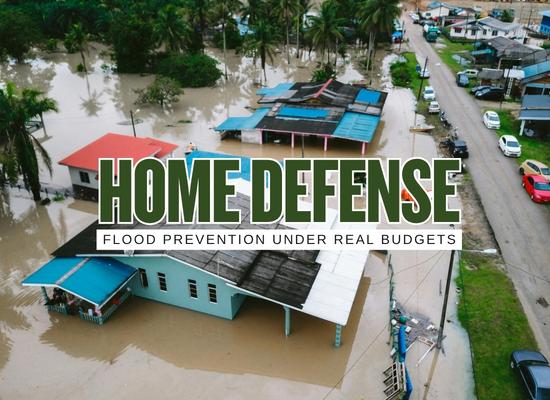
The best flood prevention upgrade is not always the biggest one. A $40 downspout fix can outperform a fancy interior project if roof water is the real problem. A $1,000 backup system can save a finished basement if the sump pump fails during a power outage. A $10,000 drainage project can be worth it when the yard keeps sending water toward the foundation.
Start with the water path
Flood prevention begins by finding the route water takes toward the home. Roof runoff, driveway slope, low foundation soil, clogged gutters, basement floor drains, crawlspace openings, low HVAC equipment, and sewer backup are all different problems. They should not receive the same fix.
The most efficient homeowner approach is to spend in layers. First, stop easy water entry. Next, add alerts and backup protection. Then upgrade drainage and equipment location. Larger projects should come after the source of water is clear, not before.
Budget ladder for homeowners
These ranges are planning numbers, not guaranteed contractor bids. Costs shift by city, soil, foundation type, excavation depth, permit rules, finished basement conditions, utility complexity, and whether the work is DIY or professional.
| Budget level | Best focus | Strong upgrades | Best fit |
|---|---|---|---|
| Under $500 | Simple water redirection and early warning | Downspout extensions, gutter cleaning, water alarms, small grading fixes, drain covers, emergency supplies | Homes with minor ponding, gutter overflow, small leaks, or no flood alert system |
| Under $2,500 | Mechanical backup and targeted protection | Sump pump replacement, battery backup, backwater valve, minor yard drainage, flood vent review, equipment platforms | Basements, crawlspaces, sewer-backup risk, low equipment, and homes with repeated nuisance water |
| Under $10,000 | Drainage redesign and stronger mitigation | French drain, curtain drain, interior drainage with sump, crawlspace flood openings, larger grading work, utility relocation | Homes with chronic water flow toward the foundation, wet crawlspaces, recurring basement water, or expensive equipment exposure |
Best upgrades under $500
Low-cost improvements that often deliver outsized value because they address common water-entry mistakes.
-
01
Fastest first move
Extend downspouts away from the foundation
Short downspouts dump roof water beside the house. During a heavy storm, that can send hundreds of gallons toward the foundation, crawlspace, garage, or basement wall. Extensions, splash blocks, buried drain lines, or flexible leaders can move water farther away.
Typical spend: $20 to $250 for basic extensions or splash blocks. More if lines are buried or tied into a larger drainage plan.Best for: Water pooling near walls, damp crawlspace edges, basement seepage after roof-heavy storms, and soil erosion below gutter outlets.
-
02
Low-cost warning
Add water leak alarms in weak spots
Water alarms do not stop flooding, but they buy time. Place them near sump pits, water heaters, basement drains, washing machines, HVAC equipment, crawlspace low points, and storage areas. Smart alarms can send phone alerts when the family is away.
Typical spend: $15 to $80 each for basic or smart sensors, depending on features.Best for: Finished basements, second homes, vacation rentals, utility rooms, and any house where a small leak can become a major repair before anyone notices.
-
03
Cheap drainage cleanup
Clean gutters and correct overflow points
Flood prevention often starts at the roofline. Clogged gutters, missing elbows, undersized outlets, and overflowing corners can concentrate water directly beside the foundation. Clearing the system and watching it during rain can reveal simple fixes.
Typical spend: $0 to $300 depending on DIY access, height, gutter guards, and local service rates.Best for: Homes with trees, visible gutter overflow, foundation staining, eroded mulch beds, or water lines under the eaves.
-
04
Small grading fix
Build soil slope away from the house
Low soil beside the foundation can create a bathtub effect. Adding compacted soil where it has settled, reshaping mulch beds, and removing water-trapping borders can help move rainfall away from walls.
Typical spend: $50 to $500 for soil, basic tools, and modest DIY grading. Larger grading belongs in the next budget tier.Best for: Negative slope, ponding next to slabs, water near crawlspace vents, and soggy planting beds touching the house.
-
05
Emergency readiness
Stage a flood response kit
A small kit can reduce damage when water starts moving. Useful items include a wet-dry vacuum, absorbent barriers, plastic storage bins, utility gloves, a flashlight, basic pump hose, extension cords rated for the job, and photos of key shutoffs.
Typical spend: $100 to $500 depending on tools already owned.Best for: Homes with occasional seepage, small basement water events, garage water entry, or seasonal storm exposure.
Best upgrades under $2,500
Targeted protection for basements, crawlspaces, sewer backup, sump failure, and vulnerable equipment.
-
06
Basement workhorse
Replace an aging sump pump
A sump pump that works during light rain may fail during the storm that matters. Replacement is especially important when the pump is old, noisy, cycling constantly, missing a check valve, discharging too close to the house, or unable to keep up during heavy rain.
Typical spend: Replacement often falls around $309 to $755, while a more complete new system can rise into the $650 to $2,500 range depending on pit, discharge, labor, and backup needs.Best for: Basements with sump pits, finished lower levels, homes with prior seepage, and properties that lose power during storms.
-
07
Power outage protection
Add a battery backup sump system
Storms that bring heavy rain often bring power outages. A battery backup can keep pumping when the main pump has no electricity or when the primary pump fails. For many finished basements, this is one of the most practical mid-budget upgrades.
Typical spend: Professional battery backup installation often runs about $600 to $1,200.Best for: Finished basements, homes with frequent outages, sump pumps that run often, and owners who travel during storm season.
-
08
Sewer backup defense
Install a backwater valve
A flood does not always enter through a door. Sewer or stormwater backup can push contaminated water up through floor drains, toilets, tubs, or basement plumbing. A properly installed backwater valve helps prevent reverse flow into the home.
Typical spend: Simpler backwater valve installations may fall around $200 to $1,000, while deeper or more complex excavation can cost much more.Best for: Older neighborhoods, combined sewer areas, basements with floor drains, low plumbing fixtures, and homes with past sewer backup.
-
09
Equipment saver
Raise small vulnerable equipment
Some flood losses are expensive because equipment sits too low. Water heaters, outlets, storage shelves, washer platforms, small mechanical components, and garage equipment may be protected by moving them higher or improving the platform beneath them.
Typical spend: $250 to $2,500 depending on the item, trade work, code requirements, and whether plumbing or electrical changes are involved.Best for: Garages, crawlspaces, utility rooms, low slabs, coastal homes, and houses with prior shallow flooding.
-
10
Targeted yard fix
Add a shallow swale or small surface drain
If water crosses the yard toward the house, a shallow swale, catch basin, short drain line, or reworked landscape edge may redirect flow before it reaches the foundation. This is especially useful when the problem is surface runoff rather than groundwater.
Typical spend: $500 to $2,500 for smaller drainage corrections, depending on distance, discharge point, and site conditions.Best for: Driveway runoff, side-yard ponding, water entering a garage, or rainwater flowing from a neighbor’s higher lot.
Best upgrades under $10,000
Larger projects for homes with repeated water problems, foundation pressure, wet crawlspaces, or high-value equipment exposure.
-
11
Foundation drainage
Install a French drain or curtain drain
A French drain moves water through gravel and perforated pipe toward a safe discharge point. A curtain drain can intercept shallow groundwater or surface flow before it reaches the foundation. These systems are useful when water repeatedly collects in the same path.
Typical spend: Smaller drainage projects may start around $500, while yard drains and perimeter systems commonly move into the $2,000 to $10,000 range depending on length, depth, soil, access, and discharge.Best for: Wet yards, water pressure against basement walls, repeated crawlspace moisture, and homes that sit below surrounding grades.
-
12
Interior water control
Add interior drainage with sump support
Interior drain tile systems do not stop water from reaching the foundation, but they can collect and move water after it enters the basement perimeter. They can be effective when exterior excavation is impractical or too expensive.
Typical spend: Many interior drainage and sump combinations can land between a few thousand dollars and $10,000 depending on basement size, concrete work, pump setup, and wall treatment.Best for: Recurring basement seepage, finished basement protection, and homes where exterior access is limited.
-
13
Flood zone structure help
Add compliant flood vents
Flood vents, also called flood openings, allow water to enter and exit enclosed areas below the elevated floor. That reduces pressure on foundation walls during flooding. They are most relevant for crawlspaces, garages, and enclosures below flood elevation.
Typical spend: A whole-home installation can range from the low thousands to several thousand dollars depending on the number of openings, wall type, engineered products, and contractor access.Best for: Homes in mapped flood areas, elevated homes with enclosed lower areas, crawlspaces, garages below living space, and owners trying to improve flood insurance rating details.
-
14
Mechanical protection
Elevate HVAC and major utilities
Flooded mechanical equipment can turn a shallow water event into a major bill. Elevating outdoor condensers, air handlers, water heaters, electrical panels, and service equipment can reduce damage and may help with insurance or code compliance in some situations.
Typical spend: $1,500 to $10,000 depending on equipment type, platform height, electrical work, refrigerant lines, permits, and whether multiple systems are moved.Best for: Coastal homes, crawlspace homes, garage equipment, low slabs, prior shallow flood damage, and high-cost HVAC exposure.
-
15
Site reshaping
Regrade the yard and rebuild drainage paths
When the land sends water toward the home, small fixes may not be enough. Larger grading work can reshape swales, correct low spots, rebuild landscape beds, redirect driveway runoff, and create safer discharge paths.
Typical spend: $2,500 to $10,000 depending on soil movement, access, retaining edges, sod, hardscape repair, drainage pipe, and erosion control.Best for: Negative slope, recurring ponding, driveway water entry, side-yard channeling, and homes receiving runoff from higher neighboring property.
Upgrade matching table
The right project depends on the water problem. This table helps match common symptoms to the most logical first upgrades.
| Homeowner symptom | Likely source | First budget move | Stronger upgrade |
|---|---|---|---|
| Water pools under downspouts | Roof runoff discharging too close | Extend downspouts and clean gutters | Buried drain line or swale |
| Basement gets wet during power outages | Sump pump stops during storms | Battery backup alarm and pump test | Backup sump system with improved discharge |
| Water comes up through floor drain | Sewer or stormwater backup | Plumber inspection and drain protection | Backwater valve installation |
| Crawlspace stays damp | Groundwater, poor grading, blocked ventilation, runoff | Downspout and grading cleanup | Drainage system, flood openings, vapor control |
| Garage takes water during heavy rain | Driveway slope, door threshold, poor surface drainage | Door seal, water alarm, surface flow check | Trench drain, regrading, swale, or driveway drainage |
| Outdoor HVAC sits low | Equipment vulnerable to shallow flooding | Document elevation and clear drainage around pad | Raised platform installed by qualified trades |
| Water pushes against basement wall | Poor exterior drainage or hydrostatic pressure | Gutter, grading, and surface drainage review | French drain, curtain drain, or interior drain system |
Flood Upgrade Priority Calculator
Use this simple planner to decide which budget tier deserves attention first. It is not an engineering report, but it can help organize the next conversation with a contractor, plumber, inspector, or insurance agent.
Select the current problem and budget to get a practical starting point.
Always confirm drainage discharge rules, permits, utility safety, and code requirements before starting work.
Insurance and resale angle
Flood prevention upgrades are not only about the next storm. They can also affect insurance conversations, buyer confidence, inspection reports, and long-term maintenance. A documented improvement is usually more valuable than an undocumented one.
- ① Keep invoices. Save receipts for pumps, valves, drainage work, grading, HVAC platforms, flood vents, and waterproofing projects.
- ② Take before and after photos. Show the weak point, the work being done, and the finished condition.
- ③ Ask about permits. Plumbing, electrical, drainage, and HVAC relocation may need local approval.
- ④ Update insurance files. Send useful mitigation documents to the agent when reviewing flood coverage.
- ⑤ Record maintenance. Sump pumps, backup batteries, gutters, drains, and valves need periodic checks.
- ⑥ Mention upgrades during resale. Buyers care more when improvements are documented and easy to understand.
Projects that need extra caution
Some upgrades can create problems when they are done casually. Flood prevention should move water to a safe place, not push it onto a neighbor, into a sewer illegally, against another wall, or under the slab.
| Project | Caution point | Better question |
|---|---|---|
| Buried downspout lines | They can clog, freeze, or discharge to the wrong place | Can the line be cleaned, and does it daylight safely? |
| French drains | They fail when slope, fabric, gravel, pipe, or discharge is wrong | Where exactly does the water go after entering the pipe? |
| Backwater valves | They require correct installation and maintenance access | Will the valve be accessible for inspection and cleaning? |
| Sump pumps | A pump is only as good as its pit, discharge line, check valve, and backup power | Will the system work during a long power outage? |
| HVAC elevation | Refrigerant, electrical, platform anchoring, and code requirements matter | Is a licensed HVAC professional handling the relocation? |
| Regrading | Moving water can create neighbor, sidewalk, driveway, or erosion issues | Does the new slope send water to a legal and stable discharge point? |
Best spending sequence
A homeowner with limited cash should not jump straight to the most expensive fix. The better move is to solve the obvious water sources first, then protect the most expensive vulnerable systems.
- ① Rain-day walkaround. Watch the home during heavy rain and record where water actually moves.
- ② Roof runoff cleanup. Fix gutters, downspouts, elbows, and discharge points.
- ③ Low-cost alarms. Put sensors at the first places water would appear.
- ④ Pump and backup review. Test the sump pump and consider backup power if the basement is valuable.
- ⑤ Sewer backup review. Ask a plumber about backwater protection if floor drains or low fixtures are exposed.
- ⑥ Site drainage design. Price swales, drains, grading, or French drains after confirming the water path.
- ⑦ Equipment elevation. Move the most expensive vulnerable systems higher when shallow flooding is realistic.
Bottom line for flood prevention budgets
The best flood prevention plan is layered. Under $500 can fix obvious roof runoff, add alarms, and improve emergency response. Under $2,500 can add real mechanical protection with sump pump upgrades, battery backups, backwater valves, small drainage fixes, and equipment protection. Under $10,000 can address larger site drainage, interior water control, compliant flood openings, and utility elevation.
The smartest project is the one that matches the actual weak point. Trace the water path first, document the problem, price the lowest effective fix, and keep proof of every upgrade for insurance, resale, and future storm planning.