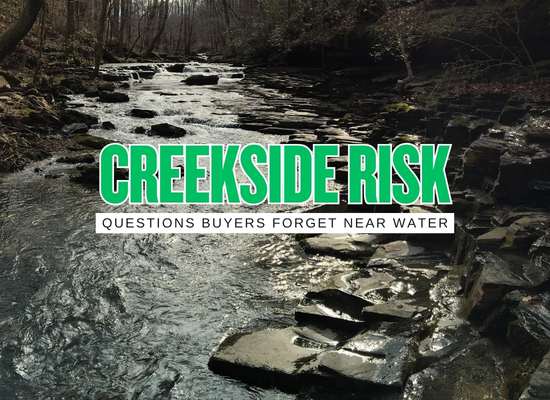
A creek, canal, bayou, drainage ditch, or neighborhood swale can make a property feel peaceful, private, and naturally scenic. It can also hide some of the most important due-diligence questions in a home purchase. Buyers often check the FEMA flood zone, glance at the seller disclosure, and assume they understand the risk. That is rarely enough. Flood risk can come from channel capacity, clogged culverts, upstream development, street drainage, roof runoff, stormwater easements, prior claims, local maintenance schedules, and insurance pricing that may not be obvious during a showing.
A home near a creek, canal, bayou, drainage ditch, or neighborhood swale can be a great buy, but the water feature should become part of the inspection, insurance, and pricing conversation. The risk is not just the water you can see from the backyard. It is the upstream drainage area, culverts, street grading, outfall capacity, easements, past flood history, local maintenance, and the cost of owning the property after the first major storm.
The water beside the home is only one clue
Many buyers focus on the visible channel: the creek behind the fence, the canal along the subdivision edge, the bayou across the road, or the drainage ditch beside the driveway. The larger question is the behavior of the entire drainage system during heavy rain.
The safest purchase process treats nearby water as a system. Buyers should look at official maps, but also ask about drainage history, seller knowledge, insurance quotes, local maintenance, yard elevation, foundation height, street ponding, public works records, and the neighbors’ lived experience. The listing may sell the view. The due diligence should test the water.
14 buyer questions people forget near creeks, canals, bayous, and ditches
These questions are designed for buyers, agents, inspectors, and lenders who want a fuller picture before the option period, inspection window, or final closing decision.
Has the home, garage, yard, street, or driveway ever flooded?
Ask separately about the structure, garage, crawlspace, shed, yard, street, and driveway. A seller may say the home never flooded, while the street, garage, or yard has repeatedly taken water. That distinction still matters for daily ownership and resale.
Does the disclosure form mention flood claims, water intrusion, or drainage repairs?
Disclosure rules vary by state, and some forms are stronger than others. Buyers should not assume a blank disclosure means no risk. Ask for clarification in writing when the property is near visible drainage.
Does the FEMA map match the risk on the ground?
FEMA maps are important, but buyers should compare the mapped flood zone with actual site conditions: channel distance, finished-floor height, street slope, nearby low points, ponding marks, and the direction water would travel if the ditch overtops.
Can the buyer get flood insurance quotes before closing?
Do not wait until the last week. Get quotes early from NFIP and private flood markets where available. Under Risk Rating 2.0, pricing can reflect property-specific characteristics, so two homes in the same general neighborhood can price differently.
Is flood insurance required by the lender or just strongly advisable?
A lender requirement often depends on mapped flood zone and loan type. Risk does not disappear simply because the lender does not require a policy. Many buyers outside mandatory zones still choose coverage because drainage and rainfall flooding can happen outside the mapped high-risk area.
Is there a drainage easement, servitude, or access strip on the property?
A drainage easement can limit fencing, landscaping, sheds, additions, grading, tree planting, and future construction. It may also give a public agency, utility district, HOA, or drainage authority access for maintenance.
Who maintains the ditch, canal, culvert, outfall, or bayou bank?
Responsibility can sit with a city, parish, county, drainage district, HOA, canal company, private owner, or the homeowner. Maintenance confusion becomes expensive when vegetation, sediment, debris, erosion, or collapsed culverts reduce capacity.
Are there upstream developments adding more runoff?
New subdivisions, shopping centers, widened roads, parking lots, and compacted construction areas can increase runoff if not properly managed. Buyers should check nearby planned developments and drainage projects, not just the lot they are buying.
Does water flow toward the house or away from it?
During a showing, look at grading from the street, driveway, side yards, back patio, neighboring lots, and the channel edge. The key question is whether the house sits as the high point or the collection point.
Are culverts, swales, and drains clear or already struggling?
Rusted culverts, crushed pipe ends, standing water in ditches, sediment bars, blocked grates, trash lines, algae, dead grass streaks, and eroded banks can indicate drainage problems that may not appear in the home inspection report.
Has the finished floor been elevated compared with nearby land?
A few inches can matter. Ask for an elevation certificate if available, especially in flood-prone areas. Compare the finished-floor elevation, garage slab, HVAC pad, and driveway low point.
Are mechanical systems and utilities above likely water levels?
HVAC units, electrical panels, outlets, tankless water heaters, generators, well equipment, sewer cleanouts, and pool equipment can be expensive weak points when placed low near drainage features.
Will future improvements be restricted?
Decks, additions, pools, sheds, fences, fill dirt, retaining walls, driveways, and landscaping may be limited by floodplain rules, drainage easements, HOA rules, wetlands, setbacks, or local stormwater ordinances.
Does the price reflect the ownership cost?
A buyer should price the home with insurance, deductibles, drainage maintenance, potential mitigation, resale concerns, and repair risk in mind. A pretty water-adjacent lot can still be a poor deal if the long-term carrying cost is hidden.
Risk clues buyers can spot during a showing
A buyer does not need to be an engineer to notice early warning signs. The goal is not to diagnose the entire drainage system during a tour. The goal is to know when to slow down and bring in stronger due diligence.
| Visible clue | Potential signal | Buyer follow-up |
|---|---|---|
| Waterline marks | Past ponding near fences, sheds, garages, crawlspace vents, or exterior walls | Ask about dates, depth, source, cleanup, repairs, and insurance claims |
| Fresh soil or new sod | Recent grading, erosion repair, ditch work, or attempt to improve drainage | Ask for invoices, permits, drainage plans, and before-and-after photos |
| Low driveway | Street water may enter the garage or block vehicle access | Check street crown, driveway slope, garage threshold, and nearby storm drains |
| Standing ditch water | Possible flat grade, blockage, poor outlet, high groundwater, or slow drainage | Ask who maintains the ditch and whether it drains after storms |
| Eroded bank | Fast flow, bank instability, repeated overtopping, or maintenance issue | Ask whether bank stabilization is allowed, required, or restricted |
| Low HVAC pad | Mechanical equipment may be exposed before the living area floods | Price the cost of elevation or replacement protection |
| Blocked culvert | Trash, sediment, vegetation, collapsed pipe, or inadequate flow path | Determine ownership and maintenance responsibility before closing |
| Neighbor pumps or barriers | Nearby homes may have recurring nuisance flooding | Ask neighbors about storm behavior and review public drainage records |
Homebuyer water-adjacent risk estimator
This tool does not replace insurance quotes, survey work, elevation data, or local drainage review. It helps buyers compare risk signals before deciding whether to negotiate, inspect deeper, request records, or walk away.
Calculator logic: the score adds risk signals from water proximity, mapping, history, grading, maintenance clarity, and utility exposure. The ownership-cost estimate combines insurance over the selected years, a deductible or event reserve, and near-term mitigation allowance. The negotiation range uses a portion of that planning reserve because sellers, lenders, and markets may treat flood exposure differently.
Records worth pulling before closing
Buyers near drainage features should go beyond the listing packet. These records help separate a manageable water-adjacent property from a property with hidden drainage risk.
| Record | Best source | Use during negotiation |
|---|---|---|
| Official flood map panel | FEMA Flood Map Service Center or local floodplain office | Confirms mapped zone, base flood information when available, and whether more review is needed |
| Elevation certificate | Seller, prior insurer, surveyor, local permit office | Helps evaluate finished-floor elevation, insurance pricing, and mitigation options |
| Flood insurance quote | NFIP agent and private flood insurers where available | Turns vague risk into annual carrying cost |
| Seller disclosure and claim history clues | Seller, agent, inspection process, insurance discussions | Identifies prior repairs, water intrusion, drainage corrections, or claim concerns |
| Drainage easement or servitude documents | Title report, survey, parish or county records, HOA documents | Shows restrictions on fences, fill, sheds, trees, access, and future improvements |
| Local drainage complaints or work orders | City, parish, county, drainage district, public works department | Reveals repeated neighborhood problems that may not be in the listing |
| Subdivision drainage plans | Planning department, HOA, drainage district, developer records | Helps identify detention ponds, outfalls, overflow paths, and maintenance duties |
| Permit history | Local building department | Checks whether additions, grading, culverts, or repairs were permitted |
Insurance questions before the option period ends
Flood insurance should be tested early because it affects affordability, lender requirements, and resale. Buyers should not rely on the seller’s old premium as a guarantee of their future cost.
- ① Quote the exact address early: A nearby water feature, replacement cost, elevation, foundation type, prior flood history, and coverage selections can all affect pricing.
- ② Ask about building and contents separately: A homeowner may protect the structure but forget personal property, appliances, tools, furniture, and garage contents.
- ③ Review waiting periods: Buyers should understand when coverage becomes active and whether closing, lender requirements, or policy changes affect timing.
- ④ Compare NFIP and private options: Private flood policies may offer different limits, exclusions, pricing, underwriting standards, and claim conditions.
- ⑤ Ask about mitigation credits: Elevation, flood openings, utility elevation, and other risk-reduction features may influence pricing or underwriting depending on the insurer.
- ⑥ Model the deductible: The annual premium is only part of ownership cost. A buyer also needs a realistic out-of-pocket event reserve.
Drainage feature comparison for homebuyers
Creeks, canals, bayous, and ditches do not behave the same way. The right questions depend on the type of water feature and the larger system behind it.
| Feature near the home | Common buyer mistake | Due-diligence focus | Negotiation angle |
|---|---|---|---|
| Creek | Judging risk by dry-weather flow | Upstream drainage area, bank erosion, bridge or culvert capacity, prior overbank flooding | Elevation data, bank stabilization cost, insurance quote, setback limits |
| Canal | Assuming water level is naturally stable | Control structures, pumps, downstream outlet, maintenance agency, tidal or backwater influence | Maintenance records, easement language, bulkhead or bank repair responsibility |
| Bayou | Focusing on scenery instead of floodplain behavior | Slow drainage, backwater, rainfall intensity, elevation, bridge constrictions, regional flood history | Flood policy cost, mitigation allowance, finished-floor comparison |
| Drainage ditch | Treating it as minor because it is narrow | Culverts, outfalls, sediment, vegetation, street runoff, driveway crossings, maintenance duty | Culvert repair, ditch cleaning responsibility, easement restrictions |
| Neighborhood swale | Filling it or landscaping over it after purchase | Designed flow path, HOA rules, municipal restrictions, yard grading, neighbor drainage | Future landscaping limits and correction cost |
| Detention pond | Assuming it is a lake amenity only | Outlet structures, HOA maintenance, sediment buildup, overflow path, mosquito management | HOA reserve strength and maintenance history |
Inspection add-ons that can change the deal
A standard home inspection may not fully evaluate drainage systems, floodplain restrictions, channel capacity, or off-site runoff. Buyers near water should consider adding targeted specialists when the risk signals are meaningful.
Buyer playbook before closing
A simple sequence can keep the buyer from getting overwhelmed. The point is not to reject every water-adjacent property. The point is to buy with clear eyes.
- ① Start with maps: Check the FEMA map, local flood tools, local drainage district maps, and any state-specific flood map resources.
- ② Quote insurance early: Get actual quotes for the address before the inspection window gets tight.
- ③ Walk the drainage path: Look at the channel, driveway, street, side yards, gutters, downspouts, culverts, and neighboring low points.
- ④ Pull records: Review disclosures, survey, easements, permits, elevation certificate, HOA records, and local drainage work orders if available.
- ⑤ Ask neighbors carefully: Neighbors often know which street holds water, which culvert clogs, and which yard drains slowly.
- ⑥ Bring in specialists when signals stack: A surveyor, civil engineer, or flood insurance specialist can be worth the cost before closing.
- ⑦ Convert risk into numbers: Price insurance, deductibles, drainage repairs, utility elevation, grading, and resale concerns.
- ⑧ Negotiate from evidence: Use quotes, records, photos, inspection findings, and maintenance responsibilities instead of vague concerns.
The practical buyer takeaway
Buying near a creek, canal, bayou, or ditch is not automatically a bad decision. Some homes are well elevated, well drained, properly insured, and located near maintained systems that perform as designed. The risky purchase is the one made with incomplete information. Buyers should treat visible drainage as a due-diligence trigger, then use maps, insurance quotes, elevation data, disclosures, public records, specialist inspections, and local knowledge to understand the true cost of ownership.