
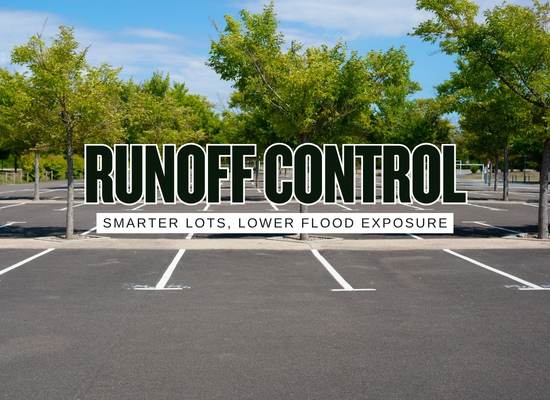
A commercial parking lot is often treated as leftover space around the building, but during heavy rain it can become one of the most important flood-control assets on the property. Asphalt, concrete, roof drains, loading areas, curb cuts, compacted soil, and undersized inlets can push water toward storefronts, warehouse doors, sidewalks, neighboring parcels, and public storm drains. The better approach is to treat the lot like working infrastructure: capture water earlier, slow it down, spread it out, filter it, store it, and release it safely.
Parking lots are not just places to store cars. On commercial sites, they are large engineered surfaces that can either push water toward trouble or become part of the solution. The same acreage that creates runoff can be redesigned to slow stormwater, filter pollutants, reduce ponding, protect entrances, and lower exposure to claims, complaints, and costly repairs.
The parking lot is part of the flood system
Many commercial flood problems begin before water reaches the building. A roof drains onto pavement. Pavement drains toward a curb. The curb directs water to an inlet. The inlet clogs or lacks capacity. The overflow moves toward a storefront, loading dock, sidewalk, neighboring property, or public right-of-way. At that point, the parking lot has already acted as flood infrastructure. It just acted badly.
The biggest opportunity sits in the difference between drainage and resilience. Traditional drainage tries to move water off the site as quickly as possible. Modern stormwater planning tries to manage water in layers: reduce unnecessary impervious area, intercept runoff near the source, store water during peak rainfall, filter polluted first flush, keep overflow paths away from doors, and maintain the system so it works during real storms.
Commercial risk hiding in plain sight
A parking lot flood is not always a dramatic event. Sometimes it is repeated ponding at the same entrance, water sheeting across ADA parking spaces, delivery trucks splashing runoff toward loading doors, clogged inlets after every heavy rain, ice formation in colder markets, or runoff leaving the property and creating complaints downstream. Those smaller events can build a record of known conditions.
10 commercial site upgrades that reduce runoff and liability
The strongest parking-lot flood plan usually combines several modest upgrades instead of relying on one expensive fix. The right mix depends on soil, slope, utility conflicts, traffic load, local code, groundwater level, maintenance capacity, and whether the property is owned, leased, or part of a larger shopping center.
Permeable pavement in selected zones
Permeable pavers, porous asphalt, and pervious concrete can let rainfall move through the surface into a stone reservoir below. This is especially useful in overflow parking, walkways, low-speed areas, fire lane-adjacent shoulders where approved, and redevelopment zones where the owner is already resurfacing.
Best fit: overflow stalls, employee parking, pedestrian zones, and areas with manageable sediment loads.
Bioretention islands inside the lot
Landscaped islands can be redesigned as shallow stormwater cells rather than purely decorative planting beds. With curb cuts, engineered soil, plants, mulch, and underdrains when needed, they can capture runoff from nearby pavement and reduce peak flow.
Best fit: large lots with excess pavement, wide drive aisles, and aging landscape islands due for renovation.
Bioswales along the perimeter
A bioswale slows and filters runoff before it leaves the site or reaches an inlet. For commercial properties, perimeter swales can be especially valuable near street edges, rear service drives, and property boundaries that generate neighbor complaints.
Best fit: sites with available edge space, long pavement runs, and visible runoff leaving the property.
Underground detention under pavement
Modular chambers, vaults, oversized pipe systems, and stone reservoirs can store stormwater below parking areas. This can be attractive for space-constrained commercial sites that cannot sacrifice many parking spaces.
Best fit: dense retail centers, medical offices, hotels, restaurants, and urban infill sites.
Inlet protection and catch-basin upgrades
Inlets fail when they are undersized, poorly placed, clogged by leaves and trash, or surrounded by pavement grades that bypass them. Upgrades can include more frequent maintenance, sediment baskets, grate changes, added inlets, trench drains, or regraded approaches.
Best fit: sites with repeated ponding near the same drain or recurring sediment problems.
Loading dock drainage separation
Loading docks are flood-prone because they often sit below surrounding pavement. Dock drains, trench drains, sump systems, backflow protection, pump reliability, and overflow routing should be reviewed separately from the customer parking area.
Best fit: grocery stores, warehouses, big-box retail, cold storage, pharmacies, and distribution facilities.
Roof runoff redirection
Roof water that dumps directly onto pavement can overwhelm a parking area during short, intense storms. Downspout extensions, underground conveyance, rain gardens, cisterns, and controlled discharge can reduce the surge entering the lot.
Best fit: strip centers, standalone stores, warehouses, churches, schools, and office buildings with visible downspout discharge.
Strategic pavement removal
Some commercial lots have more paved area than they actually need. Removing dead corners, oversized striped areas, unused stalls, or redundant pavement can reduce impervious area while creating room for landscaping, stormwater storage, and safer pedestrian routes.
Best fit: older retail lots with excessive parking counts or unused paved edges.
Safe overflow paths away from buildings
Every drainage system can be overwhelmed. The key is making sure overflow goes somewhere less damaging. Subtle grading, curb breaks, stabilized spillways, and defined flow paths can keep excess water away from doors, storefront glass, electrical rooms, and loading areas.
Best fit: properties with entry flooding even after drains are cleaned.
Maintenance records that prove the system is managed
Stormwater features are assets, not decorations. Owners should keep records for inlet cleaning, sediment removal, sweeping, plant replacement, pavement vacuuming, inspection after major storms, and repairs to broken curbs or blocked flow paths.
Best fit: every commercial site, especially properties with tenants, customer foot traffic, or recurring drainage complaints.
Upgrade comparison for owners and property managers
Commercial owners should compare upgrades by the problem they solve, not by popularity. Permeable pavement may be useful in one section and a poor fit in another. A bioswale may look simple but require careful soil design and maintenance. Underground detention may be expensive, but it can preserve parking count where land is tight.
| Upgrade | Runoff impact | Liability benefit | Cost pressure | Maintenance burden |
|---|---|---|---|---|
| Permeable pavement | Reduces surface runoff by letting water enter the pavement system | Can reduce ponding in selected areas and improve pedestrian comfort | Moderate to high depending on base depth and traffic load | Needs sweeping or vacuum maintenance to limit clogging |
| Bioretention islands | Captures runoff near the source and filters pollutants | Can reduce sheet flow across drive aisles and sidewalks | Moderate, especially during repaving or landscape refresh | Needs plant care, sediment control, and inlet clearing |
| Bioswales | Slows and filters flow along edges and discharge points | Helps reduce neighbor complaints and uncontrolled off-site flow | Low to moderate if space exists | Needs mowing or planting care, sediment removal, and erosion repair |
| Underground detention | Stores water during peak rainfall and releases it slowly | Can reduce building-entry flooding when sized and routed properly | High, but often paired with redevelopment | Needs inspection access and sediment management |
| Catch-basin upgrades | Improves collection and reduces blocked-drain ponding | Directly addresses known puddle and slip locations | Low to moderate depending on regrading needs | Needs scheduled cleaning and post-storm checks |
| Pavement removal | Reduces impervious area and creates room for green controls | Can reduce runoff and improve pedestrian layout | Moderate, but strongest during site refresh | Depends on replacement landscape or stormwater feature |
| Overflow routing | Does not reduce rainfall, but reduces damage from excess water | Protects doors, electrical rooms, docks, and neighboring parcels | Low to moderate if grading is simple | Needs inspections to keep pathways open |
Parking lot runoff reduction estimator
This planning calculator estimates runoff volume from a commercial parking area and shows how much water could be managed on site by converting a portion of pavement to stormwater controls. It is intended for early planning, not final engineering design.
Calculator logic: runoff volume uses area, rainfall depth, and runoff factor. Managed volume applies the converted area percentage and capture efficiency. Stormwater fee credit is estimated from the fee input and selected credit percentage. Actual results depend on local ordinances, engineered design, soil infiltration, underdrain layout, groundwater, construction quality, and maintenance.
Liability pressure beyond the drain
Commercial stormwater problems are not limited to property damage. Poor parking-lot drainage can create operational and legal exposure when water repeatedly crosses pedestrian routes, freezes in cold weather, erodes edges, deposits sediment, blocks ADA access, enters neighboring parcels, or backs up into tenant spaces.
| Exposure point | Commercial scenario | Smarter site response |
|---|---|---|
| Customer injury claims | Ponding at entrances, crosswalks, curb ramps, or poorly lit walk paths | Correct grading, add drainage collection, improve lighting, document inspections |
| Tenant business interruption | Water enters storefronts, stockrooms, medical suites, restaurants, or service spaces | Route overflow away from doors, protect low entries, review lease maintenance duties |
| Neighbor complaints | Runoff leaves the property and floods adjacent lots or sidewalks | Add edge controls, swales, detention, and outlet protection |
| Municipal enforcement | Sediment, trash, oil sheen, or uncontrolled discharge reaches public drainage | Install BMPs, inspect inlets, sweep pavement, maintain records |
| Pavement failure | Standing water accelerates potholes, cracking, base failure, and striping deterioration | Fix drainage before resurfacing so new pavement does not fail early |
| Emergency access disruption | Flooded fire lanes, blocked drive aisles, or inaccessible service doors | Prioritize drainage for access routes and coordinate with code officials |
Stormwater fees and the commercial property equation
Stormwater utility fees are commonly linked to impervious surface area, which means commercial parking lots can become a recurring operating cost. This is especially important for shopping centers, distribution properties, hotels, medical offices, schools, churches, restaurants, and big-box sites with large paved footprints.
The opportunity is not just fee reduction. Even when a local credit is modest or unavailable, stormwater upgrades can support lower nuisance costs, fewer tenant complaints, stronger site resilience, smoother permitting, better appearance, and a stronger position during refinancing, sale diligence, or insurance review.
Site audit checklist before spending money
A useful stormwater upgrade plan starts with a walkthrough during dry weather and another during heavy rain. The owner, property manager, civil engineer, maintenance contractor, and tenant representative may each see a different part of the problem.
- ① Map the flow paths: Mark roof discharge points, high spots, low spots, ponding areas, inlet locations, curb cuts, loading docks, and overflow routes.
- ② Review the last three storms: List the exact areas that flooded, the depth, the duration, the cleanup needed, and any tenant or customer complaints.
- ③ Inspect inlets and pipes: Check for leaves, trash, sediment, broken grates, sunken pavement, bypass flow, and blocked outlet points.
- ④ Separate customer risk from back-of-house risk: Entrances, walkways, ADA stalls, loading docks, dumpsters, and employee routes may need different fixes.
- ⑤ Check roof-to-lot connections: Downspouts that discharge onto pavement can create runoff surges that overwhelm the lot.
- ⑥ Identify removable pavement: Look for unused corners, oversized striped zones, wide medians, and low-value stalls that can become stormwater features.
- ⑦ Confirm soil and utility constraints: Infiltration, groundwater, buried utilities, contamination history, and traffic loading can change the design.
- ⑧ Review leases and maintenance duties: Determine who controls pavement, landscaping, drains, common areas, tenant entrances, and repair budgets.
- ⑨ Ask about fee credits and permits: Some projects may qualify for stormwater credits, but approvals often require engineered plans and maintenance commitments.
- ⑩ Build a maintenance calendar: Green infrastructure fails when inlets clog, plants die, sediment builds, permeable pavement clogs, or overflow paths are blocked.
Owner playbook for phased upgrades
Most commercial properties do not need to rebuild the entire lot at once. A phased approach can reduce cost shock and align upgrades with normal capital cycles.
| Phase | Practical moves | Best timing | Decision trigger |
|---|---|---|---|
| Phase 1 | Clean inlets, photograph problem zones, repaint unsafe pedestrian routes, repair broken curbs, redirect obvious downspouts | Immediately or before storm season | Recurring ponding or customer complaints |
| Phase 2 | Add trench drains, improve catch basins, correct small grading failures, protect loading docks, define safe overflow routes | During maintenance repairs or tenant turnover | Water entering doors or blocking access |
| Phase 3 | Convert selected pavement to bioretention, bioswales, permeable areas, or underground storage | During repaving, redevelopment, or capital improvement cycles | Large impervious footprint or fee-credit opportunity |
| Phase 4 | Create a formal stormwater asset plan with inspections, maintenance records, tenant communication, and post-storm review | Ongoing | Portfolio ownership, insurance review, refinancing, or sale diligence |
The practical owner takeaway
A parking lot can be a runoff amplifier or a flood-control asset. The difference is usually not one dramatic upgrade. It is the combination of cleaner inlets, smarter grading, safer overflow paths, targeted pavement conversion, better landscape design, protected loading areas, and maintenance records that prove the property is being managed. For commercial owners, the strongest site plan is the one that reduces water volume, reduces unsafe ponding, reduces complaints, and makes the next heavy rain less expensive.