
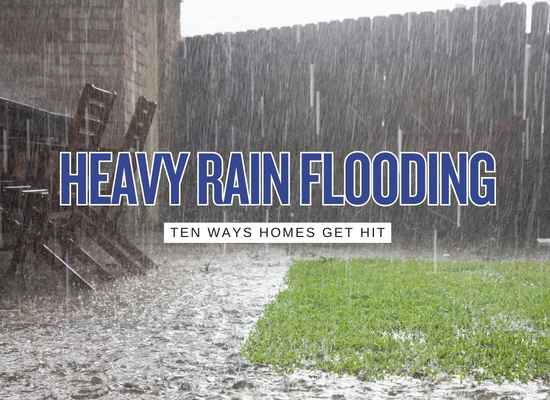
A lot of homeowners still associate serious flood damage with rivers, bayous, storm surge, or homes sitting right on the water. Pluvial flooding breaks that mental model. FEMA’s hazard methodology describes pluvial flooding as excessive rainfall that overwhelms drainage systems and leads to surface water accumulation, while FEMA’s urban flooding guidance is built around the reality that homes can take flood damage from heavy rain, surface runoff, and sewer backup even in places that do not feel river-adjacent at all. That is exactly why heavy-rain damage catches so many owners off guard.
A home can flood badly without a river ever leaving its banks
That is the central misunderstanding this article is trying to fix. A property does not need a nearby river, creek, canal, or bayou to suffer serious flood damage. Sometimes the problem is simply that rain falls faster than the ground, the storm drains, the street, and the lot can handle it. Water then starts acting like it always does. It looks for low points, weak openings, buried pathways, overloaded drains, and any route that leads downhill into the house.
This kind of flooding is especially frustrating because people often feel blindsided by it. They bought outside the obvious flood narrative, but the real threat turned out to be rain overwhelming the built environment around them.
The heavy-rain damage map in one view
| Damage pathway | How the water reaches the house | Why owners miss it |
|---|---|---|
| Low door thresholds | Street and yard runoff reaches entry points | No river nearby feels reassuring |
| Garage entry | Driveway channels water directly inward | Garage is treated as lower-stakes space until damage begins |
| Basement windows and wells | Ponded rainwater fills low exterior openings | Window well flooding feels like a local defect, not a flood issue |
| Foundation seepage | Water builds up against walls and slabs | Damage appears slowly and feels less dramatic at first |
| Sewer backup | System overload forces water back through drains | Owners often expect outside water, not inside backup |
10 ways heavy rain can damage a home without a river nearby
This is organized by water pathway, not by construction category, because pluvial flooding is really a route problem. Water finds routes. Homes pay for them.
1️⃣ Street runoff pushes water across the lot and under low doors
Pluvial flooding often starts in plain view. Rain overwhelms streets, curbs, and nearby drains, then the runoff leaves the road system and starts looking for a lower route. If the house has a low threshold, poor grading, or an exposed entry point, the water can move indoors without any river flooding at all.
This is one of the classic urban-flood setups described in FEMA’s homeowner guidance. The flood problem is local surface water, not a nearby channel leaving its banks.
2️⃣ The driveway becomes a channel into the garage
Driveways are one of the easiest pluvial-flood pathways to underestimate. A sloped driveway can function like a man-made runoff chute during intense rain, funneling water directly at the garage door. Once the garage takes water, the damage may spread into adjacent rooms, stored contents, wall materials, and low-mounted utilities.
This is a great example of a home flooding problem that feels personal and site-specific rather than river-based, even though the actual cause is still floodwater produced by heavy rain overwhelming the site.
3️⃣ Basement window wells fill and spill inside
Heavy rain does not need a river nearby to create a deep basin of water around a basement window. If surface runoff accumulates in a window well faster than it drains, that opening can become one of the most direct and destructive water entry points on the entire property. Once it overtops or leaks through, the basement or lower level can take on water fast.
NOAA’s storm-event records repeatedly describe heavy rain producing basement flooding in urban and poor-drainage settings, including water entering through basement windows and windows wells in local storm events.
4️⃣ Water ponds against the foundation and starts seeping through
Pluvial flooding does not always enter dramatically. Sometimes it builds quietly around the perimeter first. Heavy rain, poor grading, clogged drainage, or bad downspout discharge can hold water against foundation walls and slabs until seepage begins. Once that happens, the owner may experience a slow but expensive interior water problem that still traces back to rainfall overload rather than river flooding.
EPA stormwater guidance even notes that infiltration or treatment areas should be kept far enough away from a building foundation to avoid undermining the foundation or causing basement seepage. That detail matters because it shows how tightly rainfall management and home damage are linked.
5️⃣ Storm drains are overwhelmed and the neighborhood water comes back at the house
One of the defining characteristics of pluvial flooding is that the drainage system simply cannot move water away fast enough. FEMA’s hazard overview explicitly describes pluvial flooding as excessive rainfall overwhelming drainage systems and causing surface water accumulation. When that happens, the problem stops being just your lot. It becomes the neighborhood’s runoff problem arriving at your property.
This is why owners sometimes feel shocked when their house floods even though their own yard maintenance seemed fine. The flood pathway started in a broader drainage failure.
6️⃣ Sewer backup pushes water into the house from the inside out
In many urban settings, one of the ugliest heavy-rain damage pathways is sewer backup. FEMA’s localized flooding guide says sewer backup is a major cause of repetitive flooding in many urban areas. EPA guidance on sanitary sewage overflows similarly notes that when flow exceeds system capacity, discharges can end up in basements, streets, and storm sewers. That means a home can suffer major flood damage not because water crossed the doorstep first, but because the system beneath it failed under rainfall pressure.
This pathway catches people off guard because it feels like a plumbing disaster. In reality, it is often still part of the same heavy-rain flooding story.
7️⃣ The sump system loses the battle during torrential rain
A lot of lower-level water damage during heavy rain comes from the point where inflow outruns the house’s ability to pump it away. FEMA’s basement flood mitigation materials explain that basements can flood when primary pumps stop working, power goes out, or torrential rains overload the pump beyond its capacity. That is a pure heavy-rain vulnerability that has nothing to do with living near a river.
This is one reason pluvial flooding feels so personal and frustrating. The failure can happen at the intersection of rainfall intensity, site conditions, and home system limits all at once.
8️⃣ Crawlspaces and low enclosures fill from surface water and poor drainage
Homes without obvious basement vulnerabilities can still suffer serious heavy-rain damage through crawlspaces and low enclosed areas. FEMA guidance for manufactured homes and flood-prone properties notes that poor drainage usually results in ponding-type flooding, which can affect low spaces first. Once those spaces fill or stay wet, damage spreads into insulation, subflooring, utilities, and structural materials.
Because these areas are hidden, the problem often seems smaller than it is until mold, floor damage, or utility issues show up later.
9️⃣ Heavy rain on a hillside creates a damaging flow path toward the home
Pluvial damage does not have to start on flat land. Heavy rain on normally dry slopes can create fast-moving runoff or even flowing mud that heads downhill toward structures. The NFIP Claims Handbook notes that heavy rain on a normally dry hillside can create a river of liquid and flowing mud that enters a property, illustrating how intense rainfall alone can generate damaging water-and-mud pathways without a traditional river flood.
For homes below slopes, embankments, or cut lots, this can be one of the most overlooked heavy-rain threats on the property.
🔟 Repeated heavy rain quietly degrades the house even when each event looks small
Not every pluvial-flood loss is one dramatic event. Sometimes the damage pattern comes from repeated heavy rains that keep wetting the same weak areas, stressing the same drainage points, and exposing the same low openings. NOAA storm records repeatedly describe heavy-rain events that mainly caused urban and poor-drainage flooding, basement issues, road closures, and similar localized damage even when the main rivers stayed within their banks.
That is an important mindset shift. A house can be flood-damaged by a pattern of heavy-rain failures long before anyone nearby starts talking about a major river flood.
A better way to think about pluvial flood risk
Look for low routes
Water does not need a river. It needs a lower place to go.
Look for overloaded systems
Street drains, yard drains, pumps, and sewers all have limits.
Look for hidden entry points
Garages, window wells, crawlspaces, and floor drains often tell the story earlier than the front door.
Look beyond flood maps alone
Heavy-rain flood trouble often feels more local than the map language owners expect.
Heavy-rain home damage check
This tool is not a flood model. It helps you identify which pluvial-flood pathway is most likely to matter on your property.
The questions that usually matter more than river distance
| Question | Why ask it | Bad shortcut |
|---|---|---|
| Where does neighborhood runoff go when drains back up? | Shows whether the flood starts beyond your lot | My own yard looks fine, so I must be fine |
| Which openings are lowest when water starts moving across the site? | Low entry points often decide the loss first | If the river is far away, flood entry is unlikely |
| Could sewer or drain overload be part of the risk? | Not all pluvial flooding arrives from outside first | Flooding only comes through doors or windows |
| Does the lot trap water against the foundation? | Slow seepage can still produce major damage | Only dramatic visible entry counts as flood trouble |
| Is there a slope or hardscape channeling rain at the house? | Runoff route often matters more than distance to water | No river means no real flood path |