
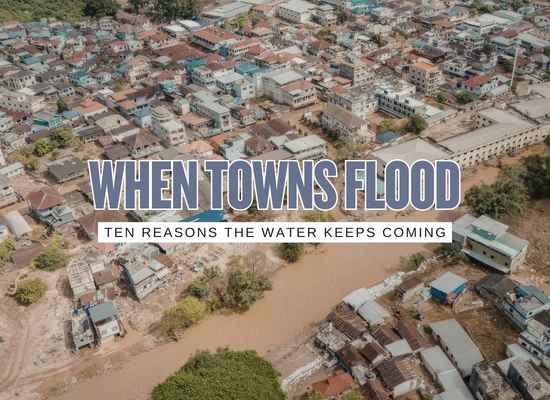
Community flooding is rarely just a weather story. Rain may be the trigger, but the real damage pattern usually depends on what kind of community sits underneath that rain: how much pavement replaced absorbent ground, whether drainage systems kept pace with growth, whether repeat-loss areas were ever taken seriously, whether floodplain rules were treated as a box-checking exercise, and whether local planning ever caught up with the water reality residents were already seeing on the streets. FEMA describes floodplain management as a community-based effort to prevent or reduce flood risk, EPA notes that urbanization and impervious surfaces sharply increase stormwater runoff, and FEMA’s CRS program exists because communities that go beyond minimum standards can measurably reduce flood losses and flood-insurance costs.
Flooding becomes a community problem long before it becomes a disaster headline
A lot of towns and neighborhoods do not flood badly because one storm happened to be unusually intense. They flood badly because the community has spent years building a flood problem into the landscape. More pavement. More runoff. Older drainage. Low-lying repeat-loss pockets that never really get fixed. Growth decisions that treat water like an afterthought until the streets, parking lots, homes, and businesses start paying the price.
That is why community flooding deserves its own kind of article. House-by-house flood advice matters, but some places are dealing with a much bigger issue than one vulnerable structure. They are dealing with a local system that no longer handles water the way the community assumes it should.
The community flood pattern in one table
| Community condition | What it usually means | Flood result |
|---|---|---|
| Rapid growth with more hard surfaces | More runoff, less infiltration | Flashier flooding and worse street ponding |
| Stormwater systems that did not keep up | Drainage capacity falls behind reality | Routine rain starts acting like a bigger event |
| Repeat-loss areas stay in place | Known weak points remain exposed | The same blocks and homes keep taking water |
| Weak floodplain management | Minimum standards do the bare minimum | Higher communitywide vulnerability over time |
| No serious long-term stormwater planning | Short fixes replace structural improvement | Flood complaints keep coming back |
10 reasons some communities keep flooding
This is less about one bad storm and more about the local conditions that keep making bad outcomes easier.
1️⃣ Too much hard surface and not enough infiltration
EPA’s stormwater guidance is blunt on the basic physics. As communities urbanize, rain and snowmelt run over impervious surfaces like streets, parking lots, and rooftops instead of soaking into the ground. That means a larger share of rainfall becomes runoff, and it gets delivered faster to low spots, storm drains, creeks, and streets.
This is one of the biggest reasons community flooding gets worse over time even without a dramatic change in public awareness. The landscape quietly becomes less absorbent, and the flood response becomes sharper and faster.
2️⃣ Drainage systems get old while the rainfall pattern gets harder
Communities often discover their drainage problem only after residents begin saying the same sentence over and over: “It did not used to flood here like this.” EPA’s long-term stormwater planning guide says municipalities are trying to manage aging infrastructure while also dealing with changing rainfall patterns and growth pressures. That is exactly the kind of mismatch that turns ordinary rain into costly flooding.
Once that mismatch shows up, the problem rarely stays isolated. Streets, parking areas, low commercial corridors, and older neighborhoods start becoming early indicators of system strain.
3️⃣ Known repeat-loss zones stay in the community year after year
FEMA’s OpenFEMA multiple-loss dataset exists because some properties really do flood repeatedly over the life of the program. When communities leave those clusters essentially unchanged, they are not just living with flood history. They are preserving a repeat-loss pattern in place. ([fema.gov](https://www.fema.gov/openfema-data-page/nfip-multiple-loss-properties-v1))
That matters because repeated losses are not just an insurance issue. They are one of the clearest signs that a local flood problem is structural, not random.
4️⃣ Floodplain rules are treated like a minimum box-checking exercise
FEMA describes floodplain management as a community-based effort to prevent or reduce flooding and build resilience. That wording is important because it frames floodplain management as a living local responsibility, not as a one-time map exercise. Communities that only satisfy minimum requirements may stay technically compliant while still leaving a lot of risk on the table. ([fema.gov](https://www.fema.gov/floodplain-management))
This is exactly why FEMA’s CRS program exists. The whole point is to reward communities that go beyond the minimum because stronger local management can reduce both damage and insurance costs. ([fema.gov](https://www.fema.gov/floodplain-management/community-rating-system))
5️⃣ Development decisions keep adding runoff faster than infrastructure can absorb it
One of the hardest community flood truths is that economic growth and flood pressure often move together when stormwater planning does not keep pace. New rooftops, roads, parking lots, and construction disturbance all add up. EPA’s stormwater materials repeatedly emphasize that runoff from impervious surfaces creates both water quality problems and flooding pressure.
In practical terms, communities can accidentally build themselves into a future flood complaint map if drainage, storage, and runoff control do not evolve with growth.
6️⃣ Green stormwater tools never become part of the serious plan
EPA explicitly promotes green stormwater infrastructure because it reduces and treats stormwater at its source while providing multiple community benefits. In plain language, communities that rely only on pipes, culverts, and reactive drainage fixes may be leaving a major resilience tool underused.
This does not mean green infrastructure solves every flood problem. It means communities that ignore infiltration, retention, and source-control opportunities often make the runoff burden harder than it has to be.
7️⃣ Residents keep thinking the flood problem is only at the house level
This is a quieter but important reason community flooding persists. When every homeowner thinks only about sandbags, sump pumps, or elevation at the individual lot, the broader failure can stay invisible. Streets flooding first, overwhelmed intersections, repeated drainage complaints, and recurring neighborhood ponding are community-scale clues that the real problem is larger than one structure.
That matters because the wrong diagnosis leads to the wrong fixes. A neighborhood-scale runoff issue will not be solved house by house alone.
8️⃣ Communities underuse mitigation funding that is meant for exactly these problems
FEMA’s Hazard Mitigation Assistance programs exist to fund actions that reduce disaster suffering and repetitive flood damage, and Flood Mitigation Assistance specifically focuses on reducing or eliminating repetitive flood damage to buildings insured by the NFIP. If a community keeps flooding and never develops a serious mitigation pipeline, it may be leaving major risk-reduction opportunities unused. ([fema.gov](https://www.fema.gov/sites/default/files/documents/fema_hma_guide_062024.pdf), [fema.gov](https://www.fema.gov/grants/mitigation/learn/flood-mitigation-assistance))
This is not a simple problem to solve, but it is an important dividing line between communities that slowly chip away at repetitive loss and communities that mainly relive it.
9️⃣ Flood information gets treated as an emergency product instead of a planning tool
NOAA’s expanding flood inundation mapping and flood research tools exist because communities need better, more actionable understanding of how water is likely to spread, not just after a warning is issued but as part of longer-term awareness. When local governments and residents use flood information only as a crisis alert, they miss a lot of the planning value. ([noaa.gov](https://www.noaa.gov/news-release/noaas-transformative-flood-inundation-mapping-expands-to-60-of-us), [nssl.noaa.gov](https://www.nssl.noaa.gov/education/svrwx101/floods/))
In other words, better flood maps and tools matter most when they change how a community plans before the next event, not just how it reacts during one.
🔟 The community never fully accepts that flooding has become part of its local identity
This may be the most uncomfortable reason of all. Some communities still talk about flooding like it is an occasional outside event instead of a recurring local condition. That mindset slows everything down. It delays better ordinances, better drainage planning, better investment priorities, and more honest conversations with residents and buyers.
The communities that improve are usually the ones that stop pretending the flood problem is temporary and start governing like water is now one of the defining local realities.
A different way to judge whether a community flood problem is getting worse
Street test
Are the same road segments flooding faster or more often than they did a few years ago.
Development test
Has the community added a lot of hard surface without an equally visible stormwater upgrade story.
Repeat-loss test
Are the same homes, blocks, or business corridors taking water again and again.
Planning test
Is the local response still mostly reactive, or is there a real stormwater and floodplain strategy.
Governance test
Has the community moved beyond minimum compliance and started acting like resilience is a long-term civic priority.
Community flood pressure check
This tool is not an engineering model. It is a simple way to organize the local signs that a community flood problem may be growing faster than many residents realize.
The community moves that change the story
| Move | What it improves | Why it matters |
|---|---|---|
| Stronger floodplain management beyond minimum standards | Reduces long-term exposure | Communities that manage floodplains better tend to manage losses better too |
| Long-term stormwater planning | Aligns infrastructure with rainfall and growth reality | Stops short-term fixes from dominating the budget forever |
| Green stormwater infrastructure | Captures runoff closer to where it falls | Reduces stress on pipes and outfalls |
| Mitigation on repetitive-loss properties | Cuts the repeat pattern directly | Breaks the cycle of recurring claims and recurring disruption |
| Better flood communication and local mapping use | Turns warning data into planning value | Helps residents and leaders act earlier and more intelligently |