
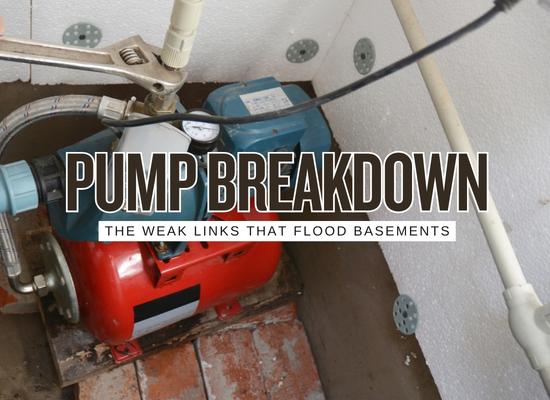
Most sump pump “failures” are not the motor dying. It is a chain of small weak links: a float that sticks, a check valve that leaks back, a discharge line that freezes or recycles water, or a backup battery that was never actually ready. FEMA maintenance guidance and flood mitigation material both emphasize keeping sump systems reliable and pairing them with backup power for flood-prone homes.
Floodmart reliability guide
Four parts cause most storm-night surprises. This guide breaks down the actual failure patterns, the giveaway clues, and the repair moves that match the mechanism.
FEMA materials also emphasize sump pump maintenance and backup power for flood resilience.
Safety first around water and electricity
If there is standing water, public safety guidance warns against operating breakers or electrical tools while in water and recommends treating electrics as unsafe until conditions are verified.
A good sump system is two things
- Capacity: it can remove water faster than water enters, even during peak inflow
- Continuity: it still runs when common failure modes hit, especially power loss
The big four failure points
1️⃣ Battery backup that is not truly ready
Failure pattern: the primary pump stops in an outage, the backup runs briefly or not at all, then the pit rises.
Clues seen before the flood: older battery, alarm chirps, charger light warnings, backup never tested under load.
Damage multiplier: outages often coincide with intense rain, so continuity matters as much as raw pumping power.
Fix logic: backup power is a common preparedness recommendation, and FEMA basement mitigation material calls battery backup a safeguard against basement flooding when the primary cannot run. Use a backup approach that matches local outage frequency and test behavior.
2️⃣ Float switch interference and sticking
Failure pattern: pump never turns on, or it runs constantly because the float does not drop, or it short cycles repeatedly.
Most common causes: tight basin, cords tangled, debris or silt restricting the float, pump too close to the wall, float hitting discharge pipe.
Damage multiplier: a perfect pump is useless if the switch cannot move freely.
Fix logic: layout and clearance in the basin matter. A quick visual check during calm weather prevents storm-night surprises.
3️⃣ Check valve backflow that quietly defeats your capacity
Failure pattern: after each pump cycle, water falls back into the pit and triggers another cycle, or the pit never stabilizes during heavy inflow.
Clues: frequent cycling, water drop sound in the discharge after shutoff, pit refilling unusually fast.
Damage multiplier: short cycling increases wear and reduces your margin during peak inflow.
Fix logic: check valves are commonly used to prevent backflow and recycling in discharge systems, and manufacturer manuals also discuss discharge column effects above the check valve that relate to airlock behavior.
4️⃣ Discharge line problems frozen blocked recycled routed wrong
Failure pattern: pump runs but water does not leave, or it leaves and comes right back to the foundation, or the line freezes and seals shut.
Clues: ice at the outlet, soggy soil where the discharge empties, repeated flooding even though pump audibly runs, visible kinks or crushed sections.
Damage multiplier: a blocked discharge turns the sump pit into a holding tank with no exit.
Fix logic: discharge routing and cold-weather depth matter. Recent Liberty installation guidance notes frost-line considerations and discusses check valve decisions when plumbing cannot be placed below frost conditions.
A failure mode many people misdiagnose airlock
Air can become trapped in the pump housing or discharge, leading to a situation where the pump runs but does not move water.
Liberty manuals describe airlock and mention anti-airlock features, and Zoeller manuals describe drilling an air vent hole below the check valve to help prevent airlock.
Six more weak links that show up in real basements
5️⃣ No backup power plan for long outages
Pattern: backup exists but is undersized for the outage length or storm duration.
Clue: backup runs for a short period, then stops while inflow continues.
Fix logic: public preparedness guidance commonly recommends sump pumps with backup power, and FEMA utility guidance discusses reliable backup power as part of reducing residual risk.
6️⃣ Basin too small for the pump and switch geometry
Pattern: short cycling and float interference become normal behavior.
Clue: pump starts every minute or two during moderate rain.
Fix logic: the basin is part of the system. More usable volume can mean fewer starts and more reliability.
7️⃣ Debris silt and fines that clog the intake
Pattern: pump runs but output is weak, or pump makes unusual noise.
Clue: muddy basin, grit at the bottom, reduced flow over time.
Fix logic: periodic cleaning and keeping inlet paths clear prevents a slow decline that only shows up under stress.
8️⃣ Shared discharge and poor connections that leak or choke
Pattern: leaks near joints or reduced performance from constrictions.
Clue: wetness around fittings, rattling sections, visible kinks in flex connectors.
Fix logic: keep the discharge path smooth and well supported.
9️⃣ Alarm missing or ignored
Pattern: pit rises unnoticed until water reaches the slab.
Clue: no audible alarm, no notification, no routine test.
Fix logic: an alarm does not pump water, but it creates time, and time reduces damage.
🔟 Discharge water aimed at the foundation
Pattern: the pump moves water, but the yard sends it right back toward the house.
Clue: discharge ends close to the wall or drains into a saturated low spot.
Fix logic: route water to a stable discharge point that stays away from the structure footprint.
Scan table that turns symptoms into likely causes
| Symptom | Likely failure point | Fast verification | High payoff correction |
|---|---|---|---|
| Pump silent, pit rising | Power or float switch failure | Check breaker and float movement clearance | Free float path, correct switch layout, add alarm |
| Pump runs, no water exits | Discharge blockage, freeze, or airlock | Check outlet flow, inspect line, listen for flow | Clear outlet, address freeze risk, use airlock prevention method |
| Rapid cycling | Check valve leakback or small basin | Listen for backflow after shutoff | Repair valve, adjust geometry, increase usable volume |
| Runs constantly in storms | Inflow exceeds capacity or discharge recycling | Observe pit trend over 10 minutes | Improve discharge routing and reduce exterior water load |
| Backup exists but still flooded | Battery not ready or undersized runtime | Load test behavior and alarm | Upgrade battery capacity and test routine |
Interactive tool Sump reliability stress test
This tool estimates two things that drive storm outcomes: whether backup runtime matches outage length, and how much leakback can increase cycles.
It is a planning model for decision making, not an engineering certification.
Battery backup estimate
Check valve leakback stress
Result
Enter values and run.
Battery method: usable watt-hours = AH × V × efficiency. Runtime hours = usable watt-hours ÷ (watts × duty cycle).
Leakback method: extra gallons per hour = leakback × cycles per hour.
A practical reliability pattern that covers the most failures
- Primary pump sized for normal peak storms
- Backup power sized for realistic outage duration
- Float clearance that stays clear even with silt
- Discharge route that cannot freeze, clog, or recycle water back
- Alarm that provides time when something shifts