
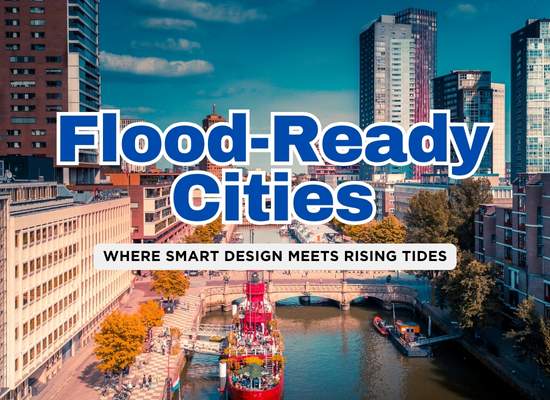
Flooding is no longer a once-in-a-century event—it’s now a reality for coastal towns, riverfront metros, and inland suburbs alike. But while many cities struggle to keep up, others are stepping up with bold, smart, and often surprising solutions.
From underground tunnels to green roofs and AI-powered drainage, these cities are proving that you can outsmart rising water with the right mix of infrastructure, innovation, and political will. Here are 10 cities leading the global charge in flood resilience.
1️⃣ Rotterdam, Netherlands 🇳🇱
- Known as one of the most flood-resilient cities in the world, thanks to its cutting-edge water management
- Features a massive network of levees, storm surge barriers, and floodplains engineered to hold back the sea
- Public spaces double as water storage—like Water Square, which captures excess rain during storms
- City embraces “Room for the River” design, letting water flow safely rather than trying to block it entirely
- New developments must meet high flood-proofing standards before approval
📌 Rotterdam doesn’t just fight water—it works with it.
2️⃣ New Orleans, Louisiana 🇺🇸
- A city hit hard by Hurricane Katrina, New Orleans has since rebuilt with flood resilience at its core
- Massive investments in levees, pumps, and drainage upgrades since 2005
- Green infrastructure projects like rain gardens and permeable pavement help absorb rainfall
- New flood maps and stricter building codes guide future development in vulnerable areas
- Community programs help residents raise homes, install backflow valves, and prepare for emergencies
📌 Turning hard lessons into one of the most flood-aware metros in the U.S.
3️⃣ Tokyo, Japan 🇯🇵
- Beneath Tokyo lies the world’s largest underground flood water diversion system: the G-Cans Project
- This massive stormwater tunnel network redirects floodwater from rivers and drains into giant silos
- Surface-level infrastructure includes elevated riverbanks, floodwalls, and smart drainage monitoring
- City planners actively adapt zoning, development, and transit to flood and quake risks
- Public education campaigns ensure citizens know what to do before the water rises
📌 A high-tech, underground fortress keeping a megacity above water.
4️⃣ Singapore 🇸🇬
- Invested billions in a multi-layered flood protection system, including the Marina Barrage, which acts as a tidal gate and reservoir
- Upgraded drainage across the city to handle more intense rainfall events caused by climate change
- Mandates that new developments incorporate rainwater harvesting, green roofs, and flood protection baselines
- Uses smart sensors and AI forecasting tools to detect and respond to heavy rain in real time
- Public education and detailed flood hazard maps help residents stay aware and prepared
📌 A city that blends urban planning, water tech, and climate foresight like few others.
5️⃣ Copenhagen, Denmark 🇩🇰
- Designed a “Cloudburst Management Plan” after severe floods, turning streets and parks into temporary waterways during storms
- Uses blue-green infrastructure like bioswales, rain gardens, and retention ponds integrated into public space
- Elevates and protects key transit and utility systems from water intrusion
- Encourages community involvement in stormwater management through local action grants
- New housing projects are required to meet strict flood-resilient criteria
📌 Where flood planning is baked into parks, streets, and daily life.
6️⃣ Jakarta, Indonesia 🇮🇩
- Facing sea level rise and rapid urbanization, Jakarta is undergoing one of the world’s most ambitious flood adaptation plans
- Constructing a massive coastal sea wall (the “Giant Sea Wall Jakarta” project) and artificial islands to protect the city
- Resettling vulnerable communities and improving storm drainage in low-lying areas
- Investing in green infrastructure, river normalization, and early warning systems
- Plans are in motion to gradually shift key government operations to a new inland capital (Nusantara) for long-term resilience
📌 A city battling nature with urgency, scale, and some truly bold moves.
7️⃣ Miami, Florida 🇺🇸
- Investing over $4 billion in stormwater pumps, road elevation, and seawalls as part of the “Stormwater Master Plan”
- Using porous pavement and raised infrastructure to fight sunny-day flooding caused by sea level rise
- Zoning reforms discourage construction in high-risk areas and encourage green building retrofits
- Miami Forever Bond funds major resilience infrastructure through a voter-approved initiative
- Public-private partnerships fund innovation in flood detection and property protection
📌 Fighting rising tides one raised street and smart sensor at a time.
8️⃣ Hamburg, Germany 🇩🇪
- Developed a “living with water” approach to urban design along the Elbe River
- HafenCity, Europe’s largest inner-city development, is built on raised platforms to stay above 100-year flood levels
- Storm surge barriers and real-time monitoring systems protect critical infrastructure
- Integrated floodplains absorb excess water during high tides and rain events
- Strong community engagement and transparent planning make resilience a public priority
📌 A model of mixing modern urban design with historic water wisdom.
9️⃣ Bangkok, Thailand 🇹🇭
- Surrounded by rivers and sinking annually, Bangkok has embraced nature-based solutions
- Constructed massive green spaces like Centenary Park that double as flood retention basins
- Expanding canal dredging, pump stations, and early warning systems across the city
- Promotes water-sensitive urban design in new construction and roads
- Education campaigns help communities build sandbag barriers and protect low-lying homes
📌 Harnessing green spaces and cultural know-how to adapt in real time.
🔟 Hoboken, New Jersey 🇺🇸
- Once devastated by Hurricane Sandy, Hoboken has since become a flood resilience leader
- Built the Rebuild by Design “Resist, Delay, Store, Discharge” system combining seawalls, parks, and pumps
- Elevated parks store and absorb rainwater while offering recreation year-round
- Green roofs and rain gardens are encouraged through citywide incentives
- Community flood response teams and transparent alert systems keep residents in the loop
📌 Small city, big innovation—with the playbook other cities are now borrowing from.
Floods aren’t just a coastal problem anymore—and these cities aren’t waiting around for the next disaster. They’re redesigning streets, rethinking infrastructure, and reshaping the way communities live with water.
Whether it’s underground super-tunnels, elevated neighborhoods, or parks that double as reservoirs, these cities show that smart planning, bold investment, and public engagement can turn the tide on flooding—literally.