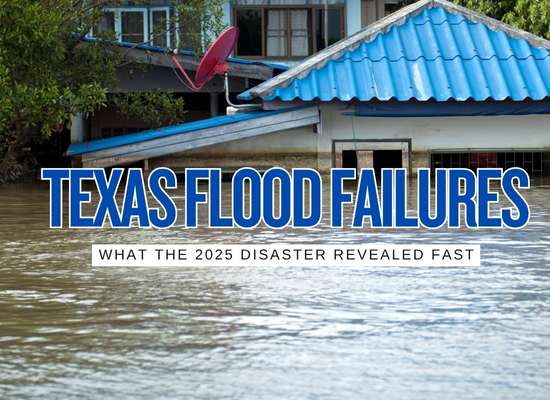
In early July 2025, Central Texas faced a devastating flash flood that surged rivers over 20 feet in under two hours. Nearly 95 lives were lost, including dozens of children at Camp Mystic. The tragedy was predictable, a dangerous blend of steep terrain, intense rainfall, and outdated systems and yet its scale stunned the region. These floods exposed gaps in infrastructure, preparedness, leadership, and climate adaptation that communities across the country can’t afford to ignore. What follows are 12 lessons learned from this disaster; here are the first three, drawn from expert analysis and post-event investigations.
1️⃣ Flood Warnings Failed Locally, Even When Forecasts Arrived
Despite National Weather Service forecasts issued hours before the flood struck, local alert systems often did not transmit warnings effectively. In rural parts of Kerr County, sirens were absent, cellular connectivity was poor, and push alerts came only after flooding began, leaving many campgrounds unaware until it was too late.
The takeaway: high-quality forecasts mean little if local communication infrastructure or protocols don’t deliver timely alerts to the people on the ground.
2️⃣ Long-Predicted Risks Went Unheeded
Experts and officials had warned of the severe flood risk in the Guadalupe River basin for years—and plans to install a multimillion-dollar early warning system dated back to at least 2016. But funding delays and political opposition left Kerr County without sirens or modern river gauge coverage when the flood struck.
Lesson: planning isn’t enough without sustained investment and accountability to actually implement safety-critical infrastructure.
3️⃣ Terrain Combines with Climate to Amplify Impact
The Texas Hill Country—known as “flash flood alley”—has steep hills and karst geology that rapidly funnel rainfall into rivers. When the remnants of Tropical Storm Barry brought months’ worth of rain in hours, the result was a flash flood of historic scale. Climate scientists emphasize that warming temperatures make such intense events more likely in coming years.
Bottom line: communities in vulnerable terrain must assume flash floods will intensify—and must build systems accordingly.
4️⃣ Camps and Outdoor Programs Were Left Exposed
One of the most tragic elements of the Texas floods was the loss of young lives at summer camps located along riverbanks. Camps in the region lacked formal evacuation protocols, weather-trained staff, or dedicated flood alert systems. Some relied on group texts or word-of-mouth instead of coordinated warnings, and few had raised shelters or hardened infrastructure.
Lesson: Any facility housing children or large groups outdoors—especially near water—must have real, practiced emergency plans, including on-site alarms and clearly marked flood escape routes. Nature is part of the draw, but it comes with responsibility.
5️⃣ Rescue Infrastructure Struggled to Respond in Time
As rivers rose and roads disappeared, rescue teams faced blocked access, limited air support, and overwhelmed 911 systems. In rural counties, many volunteer responders lacked high-water vehicles, drones, or night-vision equipment. Communication between agencies was patchy, and resource-sharing across counties came too late to save some lives.
Lesson: High-risk flood zones need proactive, inter-agency emergency strategies—including joint training, mobile communications kits, and region-wide mutual aid pacts ready to activate before a flood hits.
6️⃣ Urban Areas Aren’t the Only Places That Need Tech
Many flood tech investments—like smart sensors, real-time dashboards, and water-level alert apps—are concentrated in cities. But rural areas face some of the highest risk and have the least connectivity. The floods revealed a stark digital divide: some residents had access to mobile radar apps and alert systems, while others had no internet, limited service, and no access to local news.
Lesson: Tech doesn’t protect people unless it’s distributed equitably. Rural communities need better broadband, expanded weather alert coverage, and scalable tools for tracking and sharing flood data—even offline.
7️⃣ Flood Maps Were Outdated and Misleading
Many properties flooded in July weren’t even in designated flood zones. Residents and business owners thought they were safe because FEMA maps hadn’t been updated to reflect recent development, altered water flow, or increased rainfall intensity. As a result, many didn’t carry flood insurance and had no plan for rising water.
Lesson: Flood maps are often years behind reality. Communities should conduct independent flood risk assessments—especially in fast-growing regions or those near rivers—and treat “low-risk” areas with more caution than the paperwork suggests.
8️⃣ Messaging Broke Down in a Moment of Crisis
When seconds mattered, public messages were inconsistent. Different agencies posted warnings at different times, using different terminology. Some alerts were vague or technical. Others gave generic instructions that weren’t actionable. In some cases, people received alerts for one county while living in another, causing confusion and hesitation.
Lesson: Crisis communication needs to be unified, plainspoken, and local. Messages should focus on what people need to do right now—not technical jargon. Pre-scripted alerts with location-specific guidance can save time and lives.
9️⃣ Community Memory Was Shorter Than the River’s Reach
Locals recalled the historic 1987 and 2002 floods, but development along rivers moved forward anyway. Homes, camps, and cabins crept closer to the water year after year. Even longtime residents were caught off guard by how quickly this flood rose—many said they’d never seen anything like it, despite living in “flash flood alley.”
Lesson: Complacency is dangerous. Communities must preserve flood memory and teach it—through signage, education, and transparent development decisions. Rivers remember even when people forget.
1️⃣0️⃣ Insurance Didn’t Cover the Real Damage
Many families learned too late that standard homeowners insurance does not cover flood damage. Even in areas labeled as low-risk, properties were completely submerged. Those without flood insurance faced staggering out-of-pocket losses. Others with minimal coverage found that cleanup, mold remediation, and temporary relocation costs exceeded their policy limits.
Lesson: If your home is anywhere near a creek, drainage ditch, or low-lying area, flood insurance should be treated as essential—not optional. Too many Texans are rebuilding without help.
1️⃣1️⃣ Volunteer Networks Stepped In Before Institutions Did
While some counties struggled with delayed or overwhelmed emergency services, volunteers showed up within hours: pulling survivors from floodwaters, delivering food to cut-off neighborhoods, and organizing donation drop-offs. From church groups to local teens with pickup trucks, grassroots response outpaced formal systems in many areas.
Lesson: Community resilience depends on people, not just systems. Strong local networks—when supported and coordinated—are often the first line of defense in disaster recovery.
1️⃣2️⃣ Flood Recovery Is a Marathon, Not a Headline
As news cameras move on, survivors remain. Entire neighborhoods in Central Texas are still cleaning out mud, dealing with insurance delays, or struggling with trauma. Rebuilding isn’t just physical—it’s emotional, financial, and long-term. Communities without steady support risk being forgotten between disasters.
Lesson: Recovery needs sustained attention and funding. The hardest part comes after the water recedes—and that’s when solidarity matters most.
The July 2025 floods didn’t come out of nowhere. They came from a mix of known risks, ignored warnings, and deep cracks in how we prepare for and respond to extreme weather. Texas is far from alone—coastal towns, inland cities, and rural communities across the U.S. are facing similar dangers.
This storm should not be remembered only for what it destroyed. It should be remembered for what it revealed—and what it demands we fix.