
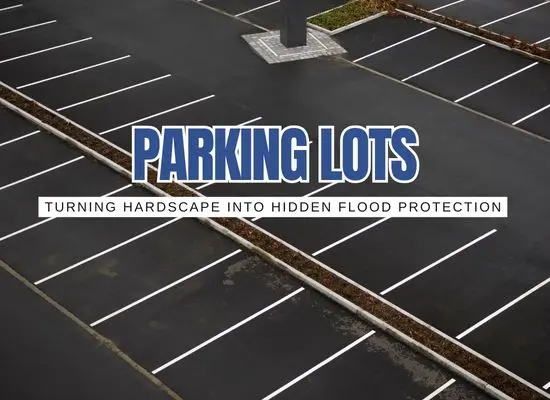
From parking lots in Houston to courtyards in New Jersey, businesses are quietly reshaping concrete into something closer to a sponge. Instead of watching water race straight into drains and back up at the worst moment, they are swapping in pavements, plantings and storage that actually soak and slow the storm. The shift is not just “green landscaping.” It changes flood risk, insurance conversations, and sometimes even stormwater fees. The guide below walks through 11 practical ways commercial properties are being re-engineered to absorb water, with simple notes on where each upgrade really fits.
Use this as a menu of upgrades when you review capital plans, resurfacing projects or site work. You do not need all eleven. Picking two or three that fit your site can sharply cut ponding, flooded entrances and backlogged drains during heavy rain.
How leading sites are using these ideas
- Pairing resurfacing projects with permeable pavement in only the worst ponding zones.
- Redirecting roof drains away from loading docks toward rain gardens or underground chambers.
- Using tree trenches and planters along the customer side of the building for both shade and stormwater.
- Layering smaller moves such as curb cuts, inlet retrofits and slope tweaks instead of one large deep tank.
| Frequent nuisance ponding | Start with permeable stalls, trench drains and micro grading tweaks. |
| Major flood history | Look at storage volume: underground chambers, cisterns and multiple green areas. |
| Regulated stormwater fees | Target measures that reduce “effective impervious area” to support fee credits where available. |
Permeable parking stalls in the worst ponding zones
Permeable pavers or porous asphalt are installed in selected parking rows or stalls, usually where water always collects. Instead of forcing all rainfall to run off, these surfaces let water pass through into a stone base and then into the soil.
Most sites do not convert the entire lot. They treat problem bands of stalls and combine them with conventional pavements elsewhere to control cost.
- Supermarket, hospital or office lots with visible ponding after storms.
- Expansive “sea of asphalt” sites in flat terrain where slope is limited.
- Municipalities that offer stormwater fee credits for permeable pavement area.
Rain gardens that capture roof and parking runoff
A shallow, planted basin that receives runoff from roofs or pavement through curb cuts, pipes or surface flow. Engineered soils and plants allow water to pond temporarily, filter and then soak into the ground instead of racing into drains.
Many retrofits start by reworking existing landscape islands instead of consuming new parking spaces.
- Use hardy, regionally appropriate plants that tolerate both wet and dry cycles.
- Confirm that overflow paths are safe, controlled and do not create new low spots.
- Coordinate with maintenance teams so the garden is treated as infrastructure, not just “nice landscaping.”
Bioswales that move and treat water along the edge
A vegetated channel with engineered soil, often running parallel to parking rows or drive lanes. It slows down runoff, gives it space to infiltrate and can strip out some pollutants before overflow reaches storm pipes.
Bioswales pair especially well with sites that have long, straight edges where water naturally wants to travel.
- Can visually soften large parking lots and screen parked vehicles.
- Often easier to access with mowers or maintenance crews than isolated planters.
- Can be designed to align with snow storage or dust control practices in some climates.
Green and “blue” roofs that hold water up top
Green roofs use lightweight soil and plants to retain rainfall on the roof surface. Blue roofs temporarily store water in trays or controlled outlets without soil, then release it slowly to drains after the peak of the storm has passed.
Both options reduce how fast runoff hits ground level, which can be decisive for flood prone loading docks or alleys.
- Requires structural engineering review to confirm load capacity.
- Best aligned with roof replacement or major retrofit cycles.
- Green roofs can also improve thermal performance and amenity value for offices or hotels.
Tree trenches that combine shade and storage
A linear trench beneath sidewalks or plazas is filled with structural soil or suspended pavement cells. Trees are planted above, and runoff from nearby pavement is directed into the trench, which stores and slowly infiltrates water.
The same system supports root growth so trees live longer and provide more shade compared with tiny tree pits.
- Visually upgrades the site frontage and pedestrian routes.
- Supports sustainability branding without relying only on signage.
- Can be phased one block or frontage at a time as budgets allow.
Underground chambers that store peak storm volume
Modular plastic or concrete units are buried under parking lots or open space. They act like an underground sponge, holding stormwater during the peak of a storm and then either infiltrating it to the ground or releasing it slowly back to the system.
This is a common choice where land is valuable and visible space for ponds or large rain gardens is limited.
- Often paired with parking lot reconstruction or major utility work.
- Requires attention to inspection access, sediment control and long term maintenance.
- May support permitting approvals where cities require on site retention of a design storm.
Cisterns that let you reuse part of the storm
Tanks or cisterns capture roof runoff and store it for later use such as irrigation, washing fleets or process water where allowed. By intercepting that water, the system lowers peak discharge to storm drains.
Designs often include controlled overflow to protect the building if a tank reaches capacity during a large storm.
- Facilities with high non potable water use such as campuses, industrial sites or large landscapes.
- Regions with water scarcity, rising water rates or rebate programs.
- Buildings where roof drainage is relatively easy to bring to a single or small number of cistern locations.
Trench drains and micro grading at doors and docks
Narrow trench drains, threshold drains and subtle slope adjustments intercept water before it reaches building entries, docks or elevator pits. They feed water toward safer storage or infiltration areas instead of allowing it to pool at the door.
This is often the fastest way to address repeat “mop up” locations where staff routinely battle minor flooding.
- Coordinate with forklift and cart routes so grates do not create vibration issues.
- Confirm that new drains have a reliable downstream path and maintenance plan.
- Combine with bollards or curbs where vehicles previously pushed water toward openings.
Curb cuts that steer water into green areas
Small openings in curbs or edges let runoff leave the pavement and enter rain gardens, bioswales or other planted depressions instead of flowing directly to inlets. Inlet retrofits can also add screens or weirs that spread flow into green systems first.
This is often done in combination with resurfacing so curb and pavement transitions remain clean.
- Check that redirecting water will not overload a small green area in very large storms.
- Ensure curb cuts are visible and protected from being paved over in future maintenance cycles.
- Coordinate with street or off site drainage patterns where municipal rules apply.
Regrading and micro basins in existing open space
Modest grading changes and small depressions in lawns or unused corners are used to hold and infiltrate water from nearby pavement. The goal is to create storage without the look of a large, fenced detention basin.
These moves are often nearly invisible to visitors once turf or low plantings fill in.
- Sites that have some underused green space between buildings and lots.
- Projects with moderate budgets where reshaping land is cheaper than structures.
- Properties where appearance rules discourage obvious, fenced stormwater basins.
Flood tolerant materials where water still might reach
In areas that remain at some residual risk, such as ground floor mechanical rooms or low storage spaces, finishes and layouts are chosen so they tolerate shallow flooding. This can include raised equipment pads, sealed concrete, removable coverings and elevated power outlets where codes allow.
While this does not absorb water, it makes minor intrusions less damaging and supports faster cleanup when other systems are tested.
- Buys time if storms exceed the design capacity of green and storage systems.
- Helps risk managers document that both exterior and interior measures were considered.
- Can be phased in whenever spaces are renovated, without site work.
Mini stormwater capture calculator
Use this to get a rough sense of how much rainfall volume one project could capture on site. This is not a design tool. It is a conversation starter for budget and risk discussions.
Most business properties do not become more absorbent in a single project. They change slope in one renovation, add a rain garden with the next parking refresh and revisit roof drainage when a replacement is due. What matters is that each move is steering more water into storage, soil and planted systems and less into overwhelmed drains and doors. The eleven ideas above give facility teams a shared language with designers, engineers and insurers so that “turning the lot into a sponge” becomes a concrete, staged plan rather than a vague sustainability slogan.