
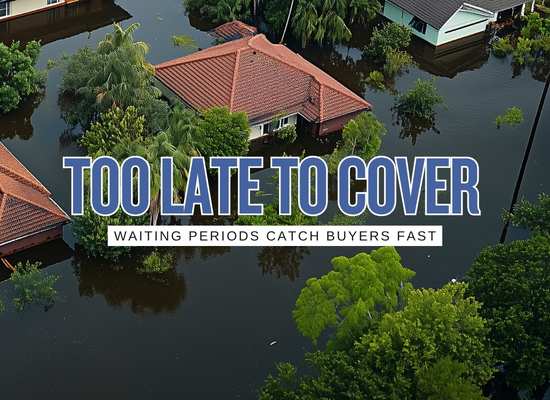
Flood insurance waiting periods catch buyers off guard because the purchase process trains people to think in closing-date terms while the policy often works on a different clock. The standard NFIP rule is that coverage usually starts 30 days after purchase, not instantly, and FloodSmart now lists only a small set of exceptions: no wait for policies bought while making, increasing, extending, or renewing a mortgage; no wait when coverage is changed at renewal; a one-day wait when a property is newly mapped into a high-risk zone and the buyer purchases within 12 months of the update; and a one-day wait for certain wildfire-related flooding on federal land if purchased within 60 days of containment. FloodSmart also notes a 30-day grace period after expiration if the premium is paid in full by the end of that window.
The waiting period problem is simple until a closing makes it messy
Most buyers do not discover the flood waiting-period issue when they first start touring homes. They discover it when a lender asks for proof, a storm is already in the forecast, a seller says the home has flood history, or an agent realizes the property needs flood coverage even though the buyer assumed that could be handled at the last minute.
That is why this topic causes so much stress. People think about flood insurance as a box to check near closing. The NFIP often treats it as a timing rule with exceptions that only work in certain situations. If the buyer misunderstands which exception applies, the gap between “we bought it” and “we are actually covered” can be much larger than expected.
The waiting-period rules in one view
| Situation | Typical timing | Why buyers get tripped up |
|---|---|---|
| Brand-new NFIP purchase | Usually 30 days | Buyers assume purchase equals immediate protection |
| Policy tied to making or renewing a mortgage | No wait | People do not realize this exception is narrow and transaction-specific |
| Coverage change at renewal | No wait | Buyers confuse renewal changes with a first-time purchase |
| Newly mapped into high-risk zone | One-day wait if bought within 12 months | People miss the timing window or misunderstand map-change dates |
| Seller policy assigned to buyer | Can preserve continuity on the property | Many buyers do not know assumption is even possible |
10 waiting-period traps that catch buyers off guard
These are the points where flood insurance timing becomes more dangerous than buyers expect.
1️⃣ Thinking flood insurance starts the day you buy it
This is the core mistake. Buyers are used to thinking in simple transaction logic. You buy something, it starts. NFIP flood insurance usually does not work that way. The standard rule is a 30-day waiting period, which means the policy can exist on paper while still not protecting the property yet.
That gap is exactly what surprises people who wait until the last moment or assume they can solve flood coverage after the rest of the home-purchase puzzle is already done.
2️⃣ Assuming every closing automatically overrides the waiting period
The mortgage-related exception is real, but buyers often stretch it too far in their minds. They hear there is no waiting period in connection with a mortgage and start assuming any last-minute flood purchase tied loosely to a transaction will behave the same way.
In practice, this is one of the most dangerous assumptions because exception language is narrower than buyer psychology. A rule that works in one closing scenario does not mean all timing problems vanish in every scenario.
3️⃣ Waiting until storm season or a bad forecast to start thinking about it
FloodSmart explicitly warns that waiting until severe weather arrives is already too late. That is not just general preparedness language. It is a timing problem built into the product itself. Buyers who postpone flood insurance because the house is not closing for a few weeks or because weather looks calm often leave themselves exposed when conditions change quickly.
This becomes even more stressful when the buyer has just taken possession and assumes the home is fully protected because homeowners insurance is already active.
4️⃣ Confusing homeowners insurance with flood protection
Another reason waiting periods catch buyers so hard is that many people do not realize how separate the flood policy really is. FloodSmart says most homeowners and renters insurance does not cover flood damage. So a buyer can close, activate standard coverage, and still have a dangerous blind spot if they assumed flood protection was included automatically.
That misunderstanding turns the flood waiting period from a technical detail into a real financial hazard.
5️⃣ Missing the map-change exception because no one tracked the date carefully
FloodSmart lists a one-day wait when a property is newly designated into a high-risk flood zone and the buyer purchases within 12 months of that update. That sounds simple until real transactions get involved. Buyers may not know the exact map-update timing, may misunderstand whether the property was truly newly designated, or may wait too long and lose the benefit of the shorter timeline.
This is one of those rules that looks generous until sloppy timing turns it into a missed opportunity.
6️⃣ Forgetting that a seller’s flood policy may be assignable
A lot of buyers assume their only option is to start a completely new policy. That is not always true. FEMA’s assignment glossary says written assignment of an NFIP policy is permissible upon transfer of title in the program, and FloodSmart’s agent FAQ says a building policy can be transferred to a new buyer. In practice, this can help preserve continuity on the property and avoid the disruption of acting like the insurance story must restart from zero. :contentReference[oaicite:1]{index=1}
This is exactly the kind of issue that gets missed when the deal team thinks only about getting a fresh quote instead of asking what already exists and whether it can move with the property.
7️⃣ Treating renewal rules like they apply to a first-time buyer
FloodSmart says there is no wait if you change flood insurance coverage while renewing the policy. Buyers can read that and think the system is more flexible than it really is. The problem is that renewal logic is not the same as first-time purchase logic. The rule that helps an existing policyholder may not help a buyer starting fresh.
That distinction matters because flood timing problems often come from people using the wrong rule from the wrong part of the policy lifecycle.
8️⃣ Not realizing an expired policy may still have a grace structure
FloodSmart states that an NFIP policy lasts for one year and that coverage will be good for 30 days after expiration as long as the premium is renewed and paid in full by the end of that grace period. That is useful, but it also creates another place where buyers and sellers can get sloppy. People hear “grace period” and assume everything is easy, when the real question is whether the premium timing and renewal handling are actually being managed properly.
This becomes especially important in transactions where the seller already has coverage and the buyer thinks continuity will just happen on its own.
9️⃣ Assuming the flood that matters is the one after the policy begins
A subtler trap is that buyers focus only on whether the policy eventually goes active, not on whether the damaging flood begins before that effective point. FEMA bulletin guidance makes clear that the SFIP does not insure damage from a flood that began before the waiting period started, or before coverage became effective under the loan-closing exception, even if the property itself is damaged later in the same event. :contentReference[oaicite:2]{index=2}
That detail matters because it shows how unforgiving timing can be when a flood event is already underway.
🔟 Thinking flood insurance timing is an insurance problem instead of a transaction problem
This is the broader lesson behind all the others. Waiting periods surprise buyers because the issue lives in the cracks between lender timing, title timing, seller timing, policy timing, map timing, and weather timing. If one person assumes someone else is handling it, the buyer is the one left exposed.
The smartest deals treat flood timing like a closing item that needs its own checklist and its own deadline, not like a casual add-on that can be solved later.
A better buyer approach before closing
Ask early
Find out whether the property needs flood insurance or whether optional coverage still makes sense before you are near closing.
Check which exception really applies
Do not assume a mortgage, renewal, or map-change exception covers your situation without confirming the details.
Ask whether an existing seller policy can be assigned
Continuity may be more valuable than starting over.
Keep weather in mind
Waiting until a storm is in the picture is the wrong time to discover a 30-day rule.
Make flood timing part of the deal checklist
Treat it like financing or title, not like an afterthought.
Flood insurance timing check
This interactive tool gives buyers a simple first-pass view of whether their timing looks comfortable or risky. It is not a legal or underwriting decision. It is a practical planning tool.
The questions buyers should ask before they assume they are covered
| Question | Why it matters | Weak assumption to avoid |
|---|---|---|
| Is this a brand-new policy or a continuation/assignment situation? | The answer changes timing and continuity | “We can always just buy one later” |
| Does the mortgage-related no-wait exception actually apply here? | Prevents buyers from relying on the wrong rule | “Closing means instant coverage automatically” |
| Is the property newly mapped into a high-risk zone, and when did that happen? | A one-day wait may depend on strict timing | “It changed recently, so I should be fine” |
| Can the seller’s building policy be assigned? | May preserve continuity and reduce timing stress | “The buyer always has to start over” |
| Is there any weather urgency that makes delay dangerous? | Waiting period mistakes hurt most when storms are near | “We still have time” |