
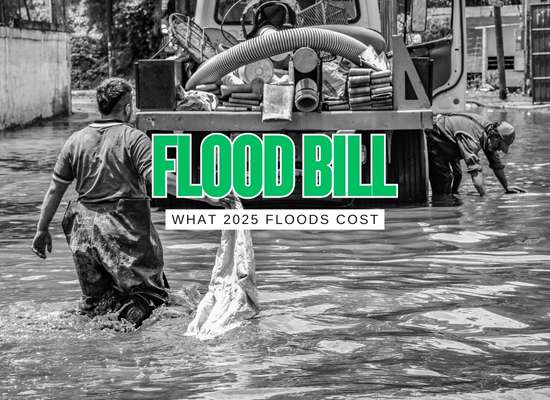
Some floods are headline events with national loss estimates. Others are quieter but still blow holes in city budgets, road networks, and household finances. Here’s a practical list of major 2025 U.S. flood events where cost figures have been publicly reported, plus a clear way to interpret what those numbers do and do not include.
🌧️
2025 U.S. Flood Costboard
A listicle of major floods where costs have been reported publicly. Costs are not all apples-to-apples, so the guide below shows how to read each number.
Cost types: economic loss, public repairs, assistance
Reality check: early numbers often change
How “cost” gets reported (and why your number might not match the headline)
Flood “costs” are commonly published in three buckets. This article labels each event using the same buckets so you can compare responsibly.
① Total damage and economic loss (big-picture estimate)
Usually includes property damage plus wider economic disruption (closures, lost wages, business interruption). Often published early by analytics or weather-risk groups. Useful for scale, not for a household budget.
② Documented public repairs and aid (government dollars)
Things like emergency funds, road reconstruction estimates, and public assistance totals. These can be very real and very specific, but they rarely represent total private losses.
③ Insurance loss (insured portion only)
Flood insurance is often separate from homeowners insurance (NFIP or private flood). Insurance totals can lag, and they exclude uninsured damage by definition.
Legend used below:
Estimated economic loss
Documented public costs
Still being tallied
Quick scan table (toggle your cost lens)
Tap a lens to show the numbers that match what you are trying to compare.
| Event | When | Estimated economic loss | Documented public costs / aid | Notes |
|---|---|---|---|---|
| Central U.S. flooding + severe storms | Apr 1–7, 2025 | $80B–$90B (reported estimate) | Varies by state, still compiling | Widespread river flooding and flash flooding across multiple states. |
| Rio Grande Valley rain + DFW hail with flash flooding | Late Mar 2025 | $1.2B (reported estimate) | Not consolidated | Event combined hail and extreme rain with rescues and flash flood emergencies. |
| Central Texas Hill Country flash flooding | Early Jul 2025 | $18B–$22B (reported estimate) | Still being tallied | Separate analysis reported $1.1B in residential building damage in the hardest-hit footprint. |
| North Central storms and flooding (Wisconsin focus) | Mid Aug 2025 | Localized estimates vary | $43.2M public-sector assessed damage; $123M+ FEMA aid to residents (reported) | Residential assessed damage reported at $33.1M in Wisconsin assessments. |
| Central Florida extreme rain and flash flooding (Lake + Brevard) | Oct 26–27, 2025 | Not consolidated | City repair line-items include $4M–$5M road reconstruction plus other projects (reported) | Local budget documents show specific projects rather than a single total. |
| Pacific Northwest atmospheric-river flooding (Washington) | Dec 2025 | Still being tallied | $3.5M initial state emergency assistance (reported) | Active response phase can delay full damage accounting. |
| Arkansas Delta crop losses tied to spring flooding | Apr 2025 | $78M agriculture damage (reported) | Varies by programs and claims | Agriculture can be a major hidden cost line even when structure damage is limited. |
Tip: If you are comparing risk year-over-year, stay inside one cost lens. Mixing “economic loss” with “public repairs” can make smaller events look larger, or huge events look oddly small.
The Top Flood Events (with published costs you can reference)
Each item includes what happened, the cost number that was reported, and the practical “what actually drives the bill” takeaway.
① Central U.S. flooding plus severe storms
Apr 1–7, 2025
What happened
A multi-day stretch of extreme rain and severe weather triggered widespread flash flooding and river flooding across parts of the central U.S. The damage footprint was broad, which is one reason the cost estimate is so large.
Reported cost
$80B–$90B
Published as a total damage and economic loss estimate.
What usually drives the bill in events like this
- Distributed damage across many counties (thousands of smaller claims add up)
- Road washouts, bridge approaches, and culvert failures
- Basement and crawlspace flooding that turns into mold prevention work
- Agricultural losses from saturated fields and delayed planting
Action takeaway
Big regional floods expose the gap between “water got in” and “the structure is dry, safe, and documented.” Your repair cost often depends on how fast you can dewater, dry, and document.
If you need a shareable reference
Use this as “reported total damage and economic loss estimate” (not “insured losses” and not “FEMA spending”).
② Central Texas Hill Country flash flooding
Early Jul 2025
What happened
Intense rainfall led to rapid rises on rivers and creeks, producing destructive flash flooding in parts of the Hill Country. Flash floods are “high-velocity” events, and that can change the damage profile compared to slow river flooding.
Reported economic loss
$18B–$22B
Published as damage and economic loss estimate.
Reported residential building damage
$1.1B
Separate analysis focused on residential structures.
Cost drivers that show up in flash floods
- Scour and undermining at foundations, slabs, and driveways
- Washed-out roads and damaged low-water crossings
- Debris impact (fences, outbuildings, HVAC pads, vehicles)
- Cleanup intensity: mud, silt, and contaminated water
Action takeaway
If your risk is flash flooding, your “repair cost reducer” is often physical resilience: keeping utilities above expected water, protecting openings, and using materials that can be cleaned and dried without demolition.
③ Wisconsin storms and flooding (Milwaukee area and beyond)
Mid Aug 2025
What happened
Heavy rain and severe storms pushed stormwater systems beyond capacity, leading to basement backups, street flooding, and infrastructure damage. This is a classic “many homes, many small repairs” flood pattern.
Assessed damages (Wisconsin)
$33.1M residential
$43.2M public sector
Documented assistance
$123M+ reported as FEMA financial assistance distributed to residents (Milwaukee County).
What moves repair costs in urban storm floods
- Basement finish level (carpet, drywall, built-ins)
- Sewer backup vs. clean rainwater (cleanup and disposal changes)
- Mechanical systems in the basement (furnace, water heater, electrical panels)
- Time-to-dry and humidity control (mold prevention)
Action takeaway
If your flooding risk is “big rain + overwhelmed drains,” look hard at backwater valves, sump redundancy, and leak detection that alerts you early enough to keep damage localized.
④ Central Florida “nearly 20 inches in 24 hours” flash flood (Lake + Brevard)
Oct 26–27, 2025
What happened
A slow-moving storm dropped extreme rainfall totals over parts of Lake and Brevard counties, triggering flash flood emergencies, road washouts, and infrastructure disruptions. Local documents show repair projects with dollar ranges rather than one single “total loss” estimate.
Documented public repair costs (examples)
- Donnelly Street reconstruction listed at $4M–$5M (project line-item)
- Additional stormwater and road projects listed in city repair documentation
Why local project lists matter
When you are trying to prove impact for grants, mitigation funding, or public works prioritization, project line-items can be more persuasive than broad regional loss estimates.
Action takeaway
For small cities, one washed-out road segment can be a multi-year capital hit. The “cost” is not only the repair; it is the projects you delay to fund it.
⑤ Pacific Northwest atmospheric-river flooding (Washington)
Dec 2025
What happened
Heavy rains and flooding triggered emergency actions and evacuations. In ongoing events, early public figures often show emergency funds, sheltering, and immediate response costs long before full damage totals are compiled.
Reported public cost signal
$3.5M
Initial state emergency assistance allocation reported during the response phase.
What to watch as the real costs emerge
- Road and rail repairs (washouts can be expensive and slow)
- Public utility impacts (water systems, power distribution, pump stations)
- Housing displacement and temporary sheltering
- Debris management and slope stabilization after mudslides
Action takeaway
For fast-moving regional events, the “cost story” often begins with response funding and ends months later with transportation and utility repair totals.
⑥ Rio Grande Valley rain plus DFW hail with flash flooding
Late Mar 2025
What happened
A combined severe-weather period included extreme rain in South Texas and damaging hail in North Texas, with flash flood emergencies and rescues reported.
Reported cost
$1.2B
Reported as total damage estimate in a billion-dollar disaster accounting.
Action takeaway
Flood risk is often packaged with other hazards (hail, tornadoes). If you are writing insurance, underwriting, or mitigation plans, treat compound events as the normal case, not the exception.
⑦ Arkansas Delta agriculture losses tied to spring flooding
Apr 2025
What happened
Flooding can create major cost lines outside residential neighborhoods. Agriculture impacts can include crop losses, replanting costs, delayed harvests, and damage to farm access routes.
Reported agriculture damage
$78M
Action takeaway
If you are tracking flood impacts for a region, do not skip agriculture and supply chain effects. In some floods, farm losses are the dominant cost story.
Owner playbook: how to use this list in the real world
If you are a homeowner
- Check if you have flood insurance (NFIP or private). Homeowners insurance usually excludes flood.
- Document fast: photos, waterline marks, serial numbers, receipts.
- Drying is a schedule problem: dewater, dehumidify, and ventilate before materials swell or mold risk rises.
If you are a contractor or mitigation pro
- Separate “clean water” vs “contaminated water” workflows. Your scope and disposal rules change.
- Build a photo log that reads like a claim file: before, during, after.
- Write scopes in plain language. The adjuster needs to map tasks to damage, not just see line items.
If you are a city or facility manager
- Track costs by project, not by “the flood.” Grants like specificity.
- Road failures often repeat at the same weak points. Prioritize drainage capacity and slope stability.
- Keep an archive: rainfall totals, closure dates, photos, invoices, contractor bids, and updated estimates.
Plain truth
A flood “cost number” is usually a snapshot of one lens. The best summaries say which lens they used and what it includes.
Data note for 2025
For national billion-dollar tracking, Climate Central notes it is now maintaining the U.S. billion-dollar disasters dataset and flags several 2025 events as still being assessed. That “still being assessed” status is one reason some flood events have project-level costs but not a single consolidated total yet.
Flood costs in 2025 were reported through a mix of broad economic-loss estimates and very specific public repair and assistance figures, and those numbers often answer different questions. If you treat each figure as a “cost lens” rather than a single universal total, the comparisons become much more useful.