
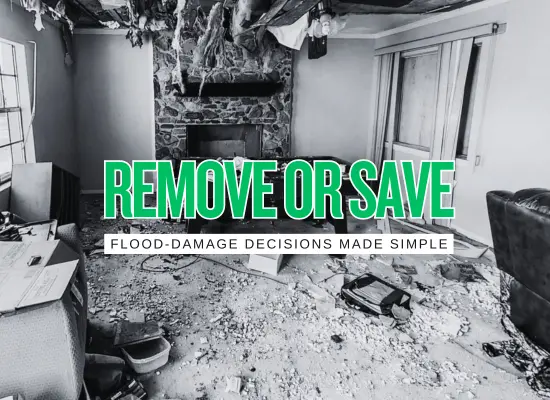
After a flood or major leak, the fastest way to cut repair costs is not “saving everything.” It is making the right removal calls early so you do not trap moisture and grow a mold problem inside your walls. This guide gives you a clear decision tree for drywall, insulation, and cabinets, plus real-world scenarios you can match to your house.
FloodMart Decision Tree
Remove vs save decisions for flood-wet walls and cabinets
Built around official mold and flood cleanup guidance: porous materials that stay wet are hard to dry fully, and mold can be difficult to remove once it grows inside absorbent materials.
Fast rules that prevent expensive mistakes
① If floodwater touched it, treat porous materials as “replace” by default
FEMA guidance commonly advises removing drywall and insulation that contacted floodwaters. Porous materials can hold contamination and moisture you cannot see.
② The clock matters: if it cannot dry fast, do not “seal it in”
A practical rule from public health guidance is that porous materials wet for more than 24 to 48 hours are likely to grow mold, especially in warm, humid conditions.
③ Mold on hard surfaces can be cleaned, porous moldy materials often cannot
EPA and OSHA guidance note that non-porous materials can often be cleaned and reused, but porous materials with mold growth may need to be discarded because mold infiltrates.
④ Never mix cleaners, and do not wing it on PPE
CDC warns never to mix bleach with ammonia or other cleaners. OSHA emphasizes respiratory protection and safe work practices during mold and flood cleanup.
Decision Tree Tool
Answer 6 quick prompts to get a “remove vs save” recommendation and next steps.
Before you start
If power or gas safety is uncertain, stop and get help. If there is standing water, pump it out safely and start ventilation and dehumidification.
Fill the prompts and click “Get recommendation.”
Material Reality Cards
What usually saves money long-term and what usually becomes a redo.
Drywall
- Best default: remove drywall that contacted floodwater, especially gray or black water.
- Why: drywall is porous and can trap moisture behind paint. Hidden wet insulation and studs are common when drywall is left in place.
- “Save” only makes sense when: clean water, very short wet time, no wicking upward, and you can verify dryness.
Insulation
- Fiberglass batt: often must be removed if wet. It loses performance and can hold moisture against framing.
- Cellulose: usually replace when wet. It holds water and can grow mold.
- Rigid foam board: sometimes salvageable if removed, cleaned, and fully dried, depending on contamination and installation details.
Cabinets
- Particleboard/MDF: usually replace if wet. It swells, delaminates, and does not return to square.
- Plywood boxes: sometimes salvageable with quick removal, drying, and re-leveling, if water was clean and exposure was short.
- Solid wood: can sometimes be saved, but doors may warp. The hidden issue is moisture trapped between cabinet and wall or floor.
Match-a-Scenario Examples
These are the calls that most often reduce total repair cost.
🏠 Scenario A: Supply line leak soaked one wall for a few hours
- If it is truly clean water and you can open baseboards, ventilate, and verify dryness, limited cuts may be enough.
- If insulation is wet behind the wall, removing a section of drywall to access and replace insulation is often cheaper than chasing hidden mold later.
🌧️ Scenario B: Stormwater entered through a door and wicked up drywall
- Cut drywall above the waterline and remove wet insulation so studs can dry.
- Cabinets sitting on wet flooring often trap moisture behind them. Pull toe-kicks and check the wall and subfloor.
🚽 Scenario C: Sewage backup or river floodwater touched cabinets and drywall
- Treat as black water. The “save” decision gets very narrow for porous materials.
- Plan on removing affected drywall, insulation, and particleboard/MDF cabinets. Clean and disinfect hard surfaces after removal, then dry thoroughly.
Safety and Cleanup Notes
Short, practical, and aligned with public health guidance.
Cleaning basics
- For hard surfaces, scrub with detergent and water, then dry completely.
- If using bleach, CDC provides a dilution guideline and warns not to mix bleach with ammonia or other cleaners.
- Drying is not optional. Mold control depends on moisture control.
PPE and work practice
- Use gloves and eye protection. Consider a respirator for moldy areas, especially when disturbing drywall.
- Bag contaminated porous debris as you remove it to reduce spread.
- If the mold area is large or you have health risks, hire qualified help.
Official guidance links (for confidence)
The right remove-versus-save call usually comes down to two things: contamination risk and whether you can truly dry and verify materials before closing everything back up. If you treat moisture as a measurement problem instead of a guess, you avoid many of the “redo” repairs that show up months later.