
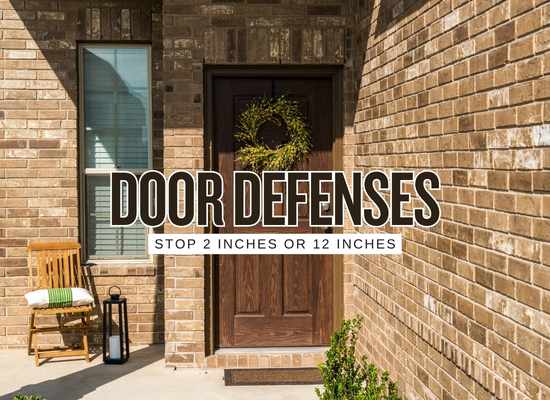
A threshold seal can be a smart way to stop nuisance water, but it is not the same tool as a door flood barrier. Once water depth climbs, hydrostatic force rises fast, and guidance on flood retrofits notes deeper water needs more substantial barriers and designs.
Floodmart comparison guide
Door flood barriers vs threshold seals
These two products solve different problems. Threshold seals target shallow nuisance water at the floor line. Door flood barriers are opening barriers intended to resist deeper water and higher pressure when a real flood is pushing on the doorway.
Two different jobs
- Threshold seal: blocks small sheet flow under a door or garage door, usually measured in fractions of an inch up to a couple inches, depending on the profile and installation.
- Door flood barrier: an opening barrier designed to create a tighter, braced seal across the entire opening, commonly used as part of a dry floodproofing approach at doors and windows.
FEMA homeowner guidance discusses shields and barriers as retrofit measures and notes that deeper water increases hydrostatic pressure and demands more substantial barrier designs.
The simple physics that changes everything from 2 inches to 12 inches
Water pressure rises with depth. Triple the depth and the force on a barrier rises by much more than triple because the pressure is higher at the bottom than at the top.
FEMA flood load guidance covers hydrostatic loading concepts, and standard hydrostatic relationships show the pressure increases linearly with depth.
The 2 inch zone
✅ Best fit in this range
- Threshold seals can be effective for nuisance water that is shallow and slow moving, especially at garage doors and low exterior thresholds.
- Door flood barriers can still be used, but the extra cost and deployment effort may not match the risk if you only see occasional shallow water.
Where 2 inches usually comes from
- Driveway sheet flow that runs toward the garage door
- Patio or walkway ponding that presses against a low threshold
- Gutter overflow that dumps water right in front of a door
Reality check on product height
Many threshold products are designed as low profiles and are marketed for keeping out water, dirt, and debris. Some flood-oriented garage threshold products are sold in taller profiles around 1.5 to 2 inches.
Examples include a 2 inch garage barrier style listing and a large garage threshold kit marketed to stop water intrusion.
The 12 inch zone
✅ Best fit in this range
- Door flood barriers are the tool designed for this level of water at an opening, because they rely on compression seals, bracing, and side channels or mounts to resist pressure.
- Threshold seals alone are usually not the right strategy at this depth. Even if a seal is tall, the rest of the doorway system becomes the weak link.
The common failure links at 12 inches
- Side leakage: water finds the jamb edges and corners if the seal is only at the floor line
- Door leaf deflection: pressure can bow doors and break the seal line
- Attachment weakness: barriers need solid anchoring to resist push and seepage
- Under-door paths: even small irregularities in the slab can become leak paths under pressure
FEMA guidance on retrofitting notes that deeper water increases hydrostatic pressure and requires more substantial barriers and shields.
The high stakes warning with deeper water
Holding water out completely can increase pressure on walls and openings, and floodproofing measures can fail if they are not matched to the flood depth and structure.
Flood retrofit materials discuss dry floodproofing and the pressures involved, and FEMA guidance emphasizes using qualified design and proper installation for higher-risk applications.
Comparison table you can actually use
| Decision factor | Threshold seal | Door flood barrier | Practical takeaway |
|---|---|---|---|
| Typical target depth | Shallow nuisance water | Deeper water at the opening | Match the product to your realistic maximum depth at the door |
| Pressure resistance | Limited, mostly at floor line | Designed to resist hydrostatic loading across the opening | At 12 inches, you are fighting pressure, not just drips |
| Leak pathways | Corners and jamb sides are common weak points | Better corner control through side channels and compression seals | Most failures start at edges and attachment points |
| Speed and convenience | Always in place, no deployment | Often deployed before a storm | Consider warning time and who will deploy it |
| Maintenance | Inspect adhesive and seal condition | Inspect gaskets, hardware, mounting points, storage condition | Both fail quietly if neglected |
| Best pairing | Drainage fixes plus a seal for small events | Barrier plus a defined overflow path away from the building | Drainage still matters even with barriers |
Interactive tool door pressure and push calculator
This estimates the horizontal push on a barrier from standing water at a door opening. It uses a standard hydrostatic relationship where pressure increases with depth.
It is a planning tool for understanding why 12 inches is a different category than 2 inches.
Result
Enter values and calculate.
Method: resultant force on a vertical rectangular surface from 0 to depth h is F = (gamma × width × h²) ÷ 2, where gamma for water is about 62.4 lb/ft³.
Practical selection logic
- Mostly 0 to 2 inches threshold seal plus drainage improvements is often the best value
- Sometimes 3 to 8 inches consider a barrier if the opening is a repeat failure point
- Up to 12 inches door flood barrier strategy, plus a plan for edges, anchors, and overflow
FEMA homeowner retrofit guidance discusses shields and barriers and notes that deeper water demands more substantial designs due to hydrostatic pressure. :contentReference[oaicite:1]{index=1}