
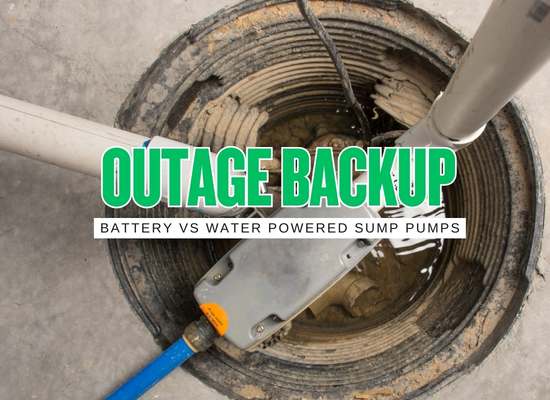
The worst time to learn your sump pump plan is incomplete is when the lights go out and the pit starts rising anyway. Battery backups and water-powered backups solve different failure modes. The “best” choice is the one that matches how your basement takes on water and what your utilities do during storms.
The real question is not “which is better”
It is “which one keeps pumping when your specific outage scenario happens” and “which one can match your inflow.”
Fast answer in one screen
- Battery backup shines when power is out but water keeps flowing, and you want predictable pumping without relying on city water pressure.
- Water-powered backup shines when you have reliable municipal water pressure during storms and you want unlimited run time without batteries.
- Well water homes: water-powered backups usually do not make sense unless you have a way to keep well pressure during an outage.
- Highest resilience: many homeowners aim for a primary electric pump plus a backup that fails differently than the primary.
FEMA’s general direction on pump reliability
FEMA flood guidance commonly points out that sump pumps need backup power if you want them to run during outages, and FEMA utility protection guidance recommends sump pumps powered by emergency power sources in flood-related applications.
How each backup works in plain language
🔋 Battery backup sump pump
Mechanism: A secondary pump runs off a battery and charger/controller. When the primary pump cannot run or cannot keep up, the backup takes over.
Strength: Works even if municipal water pressure drops, and it does not increase your water bill.
Main limitation: Run time depends on battery capacity and how often the pump must run.
Reality check from independent testing
Consumer Reports tests backup systems using a 12V deep-cycle battery with a 75 amp-hour capacity and measures performance under standardized conditions.
🚰 Water-powered backup sump pump
Mechanism: Uses municipal water pressure through a venturi to create suction and move sump water out, without electricity.
Strength: No battery run time limit. If city water pressure stays available, it can pump as long as needed.
Main limitation: Needs sufficient municipal pressure and flow, and it consumes potable water while pumping. Many models cite roughly 2 gallons of sump water removed per 1 gallon of city water used, with actual performance depending on pressure and head.
Side-by-side comparison that maps to real outage scenarios
Five decision points that actually determine success
1️⃣ Can it match your inflow rate?
The backup does not need to match the primary pump on paper. It needs to keep the water level from climbing past the critical point in your pit during the worst hour.
Water-powered models publish flow that depends on municipal pressure and head. For example, Liberty’s SJ10 documentation references minimum flow expectations at a given head and pressure, and Zoeller’s 540 FLEX technical data highlights operation within a pressure range and a typical removal ratio.
2️⃣ Do your utilities fail together or separately?
Some neighborhoods keep water pressure during electric outages. Others see pressure drops when outages are widespread.
Your local pattern matters more than any generic advice.
3️⃣ Backflow protection and code friction
Water-powered backups connect to potable water and are treated as a cross-connection risk unless protected correctly.
Liberty’s SJ10 documentation explicitly notes RPZ backflow prevention required per UPC, and ICC guidance discusses backflow preventers and cross-connection protection principles in modern codes.
Practical implication
A water-powered backup can be a great solution, but the backflow device and testing requirements in some areas become a meaningful part of the cost and maintenance planning.
4️⃣ Water use and water cost during a long event
Many water-powered systems cite about a 2:1 removal ratio (2 gallons sump water removed per 1 gallon city water used), but real-world ratio depends on pressure and head.
Municipal guidance also warns that water use will be charged on your water bill and gives an example ratio in the opposite direction for some installations, reinforcing that model and conditions matter.
5️⃣ Maintenance and testing
Backup systems fail quietly when they are not tested. Municipal maintenance handouts for water-powered backups emphasize periodic testing and upkeep, including attention to the backflow device.
Two calculators that make the choice obvious
Calculator A: Battery backup run time estimator
Use the pump label or manual wattage if you have it.
This lumps inverter, wiring, battery aging, and cold-weather effects. Conservative values are safer for planning.
Result
Enter values and calculate.
Planning formula used: usable watt-hours ≈ (AH × V × efficiency). Run time ≈ usable watt-hours ÷ (pump watts × duty cycle).
Calculator B: Water-powered cost and water use estimator
Many models advertise about 2:1, but performance depends on pressure and head.
Result
Enter values and calculate.
Practical recommendations that fit most homes
✅ A setup that covers the most failure modes
- Primary electric pump sized to keep up with normal storms.
- Backup that fails differently than the primary: battery backup if water pressure is uncertain, water-powered if pressure is reliable.
- Alarm and test routine so you find issues before the storm.
FEMA consumer guidance commonly encourages sump pumps with battery backup as a preparedness step.
Three common ways backups still fail
- Shared discharge issues: a frozen or blocked discharge line can defeat both pumps.
- Float interference: two pumps in one pit can bind each other’s floats if the pit is tight.
- No backflow protection: water-powered backups can become a code and safety problem without proper protection.
Battery backups and water-powered backups are both proven approaches, but they win in different outage conditions. If you match the backup to your local utility behavior and verify it can keep up with your inflow, you get a system that behaves predictably when storms and outages overlap.