
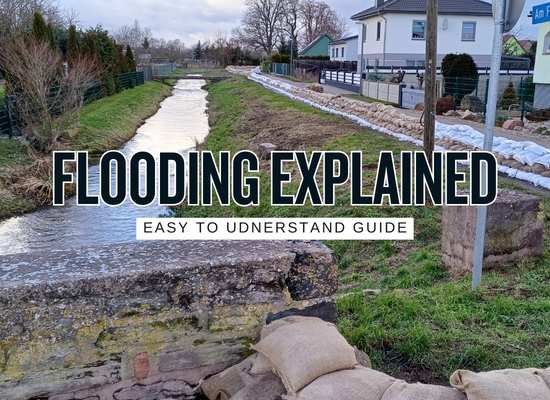
Flooding looks chaotic, but it usually follows a few repeatable patterns. Once you understand where the water comes from, where it wants to go, and why it ends up inside buildings, you can make smarter decisions about prevention, insurance, and cleanup.
FloodMart Basics
Flooding is usually a pathway problem, not a mystery
Floods generally fall into a few major categories and repeat the same physics: water moves downhill, it follows the easiest route, and it piles up when drainage and storage capacity get overwhelmed.
Plain language
Flood types decoded
Alerts explained
Simple runoff tool
The mechanics in one picture (without the picture)
①
Water arrives
Rain, snowmelt, storm surge, or infrastructure failure introduces water to an area faster than it can be safely carried away.
②
The ground and surfaces decide the split
Some water infiltrates into soil. The rest becomes runoff across pavement, yards, and slopes. USGS notes rainfall intensity and duration are major drivers, along with soil conditions and ground cover.
③
Channels and drains hit capacity
Creeks, rivers, storm drains, ditches, and culverts can only move so much water at once. Once overwhelmed, water spills into low areas and floodplains.
④
Water spreads to the lowest points
Floodwater expands into basements, garages, first floors, and any low spot. FEMA describes broad categories including riverine, coastal, and shallow flooding.
⑤
Damage depends on depth, speed, and contamination
Fast-moving water can be destructive. Slow water can soak materials for longer. Sewer backup and polluted water increase health and cleanup complexity.
Want to confirm mapping and official products for any U.S. location? FEMA’s Flood Map Service Center is the starting point:
https://msc.fema.gov/portal/search
Flood types you will hear about (and what they really mean)
| Type | Typical trigger | Fast clue you can spot | Common building entry path |
|---|---|---|---|
| Flash flooding | Rainfall overwhelms infiltration and drainage quickly. USGS defines flash floods as rapid rises from excessive rainfall runoff. | Water rises in minutes to hours, often during intense storms. | Overland flow to doors and windows, overwhelmed drains, basement stairwells. |
| Riverine flooding | Rivers and streams exceed their banks after prolonged rain or upstream runoff. | Water levels build over days and track river gauges. | Inundation of lower levels, seepage through walls, prolonged saturation. |
| Coastal flooding | Storm surge and high tides push water inland. | Saltwater influence, wind-driven rise, evacuation focus. | Direct inundation, wave-driven forces, water through openings. |
| Shallow flooding | Sheet flow, ponding, or urban drainage issues where water has no defined channel. | Water collects in yards, streets, and low bowls. | Garage doors, low thresholds, foundation vents, crawlspaces. |
| Urban drainage flooding | Stormwater systems cannot move water away fast enough. | Street ponding near storm drains, slow drain-down after rain. | Driveway-to-garage funneling, low entries, floor drains. |
| Sewer backup | Sanitary or combined systems surcharge during storms. | Gurgling drains, slow toilets, neighborhood reports. | Floor drains, toilets, tubs, low fixtures and cleanouts. |
Quick note on “flash” vs “river” flooding
USGS commonly explains flooding in terms of flash floods (rapid rise) versus river floods (slower rise), even though real events can blend categories depending on terrain and storm pattern.
If your water risk escalates quickly during storms, treat it more like a flash-flood pathway problem. If water risk builds with river level forecasts, treat it like a riverine exposure problem.
Reference: USGS flood basics and flash flood definition:
https://www.usgs.gov/faqs/what-are-two-types-floods
The most common ways water gets inside buildings
① Overland flow to the lowest opening
If water is moving across a yard or driveway, it will aim for garage doors, low thresholds, basement doors, and window wells.
Driveway funnels
Low door sills
Window wells
② Storm drains and culverts back up
When street drainage cannot clear fast enough, water level outside rises until it finds a path into structures.
Street ponding
Slow drain-down
Low intersections
③ Groundwater seepage
After prolonged wet periods, water pressure can push moisture through cracks and porous materials, especially in basements.
Musty smell
Damp baseboards
Efflorescence
④ Sewer backup
This can look like flooding, but it may be a different mechanism and sometimes a different coverage category in insurance.
Floor drains
Toilets
Cleanouts
If you are assessing flood risk for a property, pair maps with real-world history. NOAA’s Storm Events Database can help you review documented flood events by area:
https://www.ncei.noaa.gov/stormevents/
Alerts decoder: watch vs warning
Plain-language translation: a watch means flooding is possible. A warning means flooding is happening or about to happen. The National Weather Service uses these terms so people take action at the right time.
🟦
Flood Watch
Conditions are favorable. Use it as your trigger to move valuables up, check pumps, and get your plan ready.
🟥
Flood Warning or Flash Flood Warning
Flooding is imminent or occurring. A flash flood warning is about rapid-onset flooding and calls for immediate protective action.
Official definitions: National Weather Service flood watch and warning guidance:
https://www.weather.gov/safety/flood-watch-warning
Simple runoff pressure estimator (for intuition, not engineering)
This tool helps you think about overflow risk. It uses a very simplified runoff approach (not a site design model) and should not be used for permitting or engineering decisions.
Why this matters: USGS notes rainfall intensity and duration, soil conditions, topography, and ground cover all contribute to flooding. This estimator only captures a small slice of that picture.
Reference: USGS “Floods: Things to Know”:
https://www.usgs.gov/water-science-school/science/floods-things-know
Safety and health basics after a flood
Floodwater is not clean water. It can contain sewage, chemicals, and sharp debris. When mold is involved, cleanup can also pose health and injury risks.
Fast PPE checklist for mold-prone cleanup
CDC guidance for mold cleanup after disasters emphasizes personal protective equipment such as at least an N-95 respirator, eye protection, and gloves, plus safe generator practices to avoid carbon monoxide poisoning.
CDC mold cleanup guide:
https://www.cdc.gov/mold-health/communication-resources/guide-to-mold-cleanup.html
When to move fast on drying
If porous materials (carpet padding, drywall, insulation) stay wet for long periods, mold risk rises and repairs often become more invasive. If you can safely do so, the key is to stop water entry, remove soaked porous items when necessary, and start drying and dehumidification early.
A simple way to think about flood risk
✅
Step 1: Identify the likely flood type
Flash, river, coastal, shallow ponding, urban drainage, or sewer backup.
✅
Step 2: Identify the pathway to your building
Overland flow, drain backup, seepage, or surge. Water almost always chooses the lowest available entry.
✅
Step 3: Reduce exposure with the highest-leverage fixes
Runoff control, drainage capacity, backflow protection, critical system elevation, and alerting. Make it a small system, not one item.
For official flood map products and community mapping resources, start with FEMA Flood Maps:
https://www.fema.gov/flood-maps