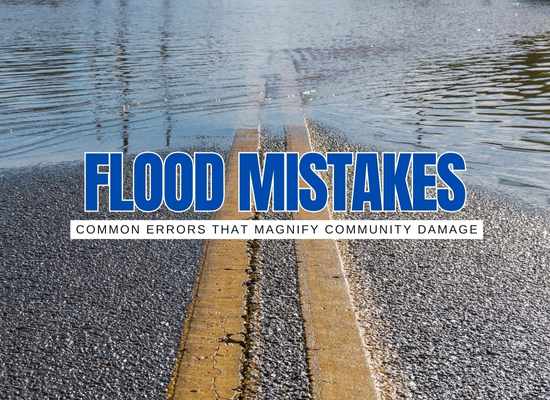
Flood losses aren’t just about too much water, they’re about choices communities make long before the sky turns dark. We’ve seen towns underbuild for the next storm, pave over the very wetlands that protect them, and skip the quiet maintenance that keeps culverts, pumps, and outfalls working when it matters most. This guide spells out the top mistakes we can’t afford to make, and what to do instead, so families, businesses, and critical services stay dry and open.
- Projects keyed only to historic BFEs and old FIRMs.
- No freeboard (extra height) above base flood elevations.
- Stormwater sizing based on outdated intensity-duration-frequency tables.
- Critical sites (schools, clinics, water plants) flood at lower thresholds.
- Insurance claims spike; premiums and NFIP issues follow.
- Emergency routes become impassable when you need them most.
- Adopt forward-looking design storms (e.g., add climate safety factors).
- Require 1–3 ft of freeboard for new builds & critical facilities.
- Use scenario mapping (near-term & 30-year) to guide siting and roads.
- Development allowed in floodways/floodplains with minimal compensatory storage.
- Tree removal without replanting targets or soil restoration.
- Surface parking sprawls with no green infrastructure.
- Higher, faster peaks overwhelm culverts and channels.
- Neighborhood flooding from “ordinary” storms becomes routine.
- Water quality declines; mold and health costs rise post-flood.
- Adopt “no net loss” in floodplains; require on-site storage offsets.
- Mandate trees/bioretention in parking lots; daylight or widen streams.
- Use permeable pavements, rain gardens, and soil decompaction standards.
- Grates clogged with leaves; debris at bridge crossings.
- Sediment-choked culverts reducing capacity by half.
- Pumps untested; backup power not exercised.
- Localized street ponding becomes home and business flooding.
- Emergency crews diverted to fix preventable blockages.
- Equipment failure during storms leads to prolonged outages.
- Stand up a seasonal inspection & cleaning schedule with photo logs.
- Exercise pumps and generators monthly; keep critical spares on hand.
- Create a public “adopt-an-inlet” program to report blockages fast.
- Opt-in only alerts with low enrollment.
- Maps with tiny fonts/no landmarks; English-only notices.
- Vague terms (“major event possible”) without actions or times.
- Late evacuations increase rescues and injuries.
- Traffic jams on a few known routes; safer roads underused.
- Small businesses lose inventory for lack of prep time.
- Use multilingual, multi-channel alerts (SMS, radio, sirens, social, door-to-door).
- Issue time-bound, action-oriented messages (“Move vehicles by 6 pm”).
- Run sign-up drives at schools, clinics, and utility bill portals.
- Annual “sandbag day” with no follow-up projects.
- Gaps at driveways/doors; bags slumped by morning.
- No pumps, check valves, or backflow preventers behind the line.
- False sense of security; water finds the weakest seam.
- Labor-intensive deployments divert responders.
- Contaminated debris and disposal bills after each event.
- Invest in portable barriers, deployable flood walls, and door dams.
- Add backflow valves, sump pumps, and sidewalk curb inlets to relieve pressure.
- Plan permanent green/grey fixes (berms, diversions, upsized culverts).
- Generators, switchgear, and fuel tanks at ground level.
- Clinics/shelters inside mapped floodplains or below grade.
- Access roads that routinely pond or overtop at culverts.
- Service outages when the community needs them most.
- Expensive emergency retrofits and relocation after the fact.
- Higher insurance costs and repetitive loss claims.
- Use enhanced siting: outside floodplains or on elevated pads with freeboard.
- Elevate/elevate: raise generators, panels, fuel, and critical files above design flood.
- Harden access: multiple routes, upsized culverts, and high-water signage.
- No basin-wide stormwater agreements.
- Upstream construction raises flood peaks in town.
- Disputes over responsibility after damage occurs.
- Downstream neighborhoods flood more often and deeper.
- Emergency costs and lawsuits rise.
- Insurance fights over “man-made” vs. natural flooding.
- Form watershed councils to share data and plans.
- Adopt basin-wide detention, retention, and infiltration standards.
- Model impacts across boundaries before approving projects.
- Same properties flood every 5–10 years.
- Residents exhausted by repeat displacement.
- FEMA claims and local aid balloon with each event.
- “Repetitive loss” premiums skyrocket.
- Communities lose credibility with federal/state agencies.
- Residents trapped in a cycle of repair and trauma.
- Prioritize voluntary buyouts with clear timelines and support.
- Use grants to elevate homes above design flood elevations.
- Repurpose bought-out land as parks, wetlands, or open space.
- Shops shuttered months after water recedes.
- No bridge loans or emergency funds for payroll.
- Families relocate permanently when services disappear.
- Local economy never recovers fully.
- Tax revenue shrinks, reducing resilience budgets.
- Talent drain as families seek stability elsewhere.
- Establish emergency revolving loan funds for local business.
- Pair federal disaster aid with technical support for reopening.
- Invest in “buy local” campaigns post-disaster to retain dollars.
- Levees built decades ago, never inspected.
- Flood maps not updated since the 1990s.
- No budget line for system upkeep.
- False confidence until the next flood hits.
- Expensive emergency repairs after neglect.
- Communities drop in FEMA’s CRS, losing insurance discounts.
- Budget for annual inspections and repairs.
- Update flood mapping and stormwater design data every 5 years.
- Build resilience into comprehensive plans, not side projects.
We’ve seen again and again that floods don’t just expose weak spots in levees and drainage, they expose weak spots in decisions. We’ve learned that when communities treat floods as rare, one-off events, the damage multiplies. We’ve also seen that when we plan for tomorrow’s storms, maintain what we build, and back local businesses and families through recovery, we come out stronger. Flood resilience is not about avoiding every drop of water, it’s about avoiding the worst mistakes that let high water turn into disaster.